Book: Two Weeks in November: The Astonishing Untold Story of the Operation that Toppled Mugabe
Author: Douglas Rogers
Publisher: Short Books / Jonathan Ball Publishers
First published: 2019
Genre: Political history, narrative non-fiction, memoir
Length: 224 pages in the Short Books edition
Reviewer: Gabriel Manyati
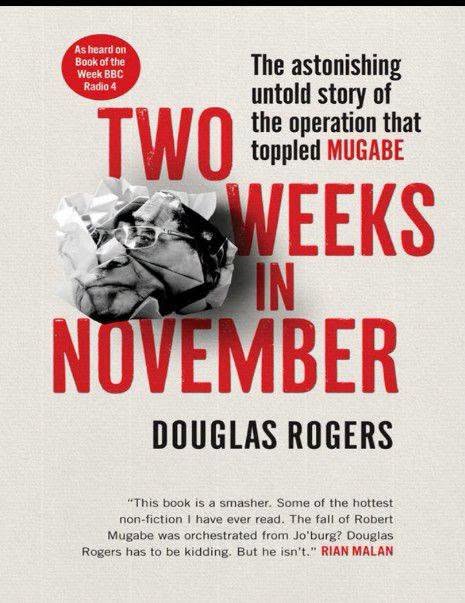
By Gabriel Manyati
The Sunday Political Read
On the night of 16 November 2017, Douglas Rogers reached the roadblock at Christmas Pass, the mountain gateway between Mutare and the Mozambique border. For 37 years, he had known that roadblock as a familiar symbol of the Zimbabwean state, usually manned by police demanding identity documents, licences and sometimes money.
That night the police were gone. Soldiers were there instead. One approached Rogers with an AK47, leaned through the window and asked, “Got any bombs?” Then he laughed, offered him a fist bump and waved him through. Behind the joke was something enormous. Zimbabwe, after 37 years of Robert Mugabe, was changing. Or so it seemed.
This review is an instalment of my weekly column, The Sunday Political Read, in which I sometimes use books not simply as literary objects but as windows into the political condition of our region.
Few books invite that treatment more compellingly than Douglas Rogers’ Two Weeks in November. Published in 2019, the book is narrative non-fiction built from hundreds of interviews, conversations, research and Rogers’ own experience. He is unusually candid about the liberties inherent in reconstructing clandestine events, acknowledging that he sometimes compressed conversations and described scenes at which he was not present.
That admission is important because Rogers is not merely recounting the fall of Mugabe. He is reconstructing the machinery behind it. His book asks us to look behind the tanks, the jubilant crowds and the resignation of an ageing dictator and examine the political operation beneath the spectacle. The result is a gripping political thriller, but its deeper value lies elsewhere. Read from Zimbabwe in 2026, Two Weeks in November becomes a disturbing study of how a political system can lose its most recognisable ruler while retaining much of the machinery that made his rule possible.
The Night Zimbabwe Changed, Or Thought It Did
The drama of November 2017 remains extraordinary. Mnangagwa had been dismissed by Mugabe on 6 November. He fled Zimbabwe. General Constantino Chiwenga returned from China. The military moved. Mugabe resisted resignation. ZANU PF turned against its long-serving leader. The opposition entered an improbable alliance with elements of the ruling party. Hundreds of thousands of Zimbabweans poured into the streets.
Then Mugabe resigned.
The country exploded in celebration. Rogers describes soldiers being lifted onto shoulders, music filling the streets and bars running out of beer. The resignation appeared to close one of the darkest chapters in Zimbabwean history.
Yet the central irony of the book is contained in what happened next. Zimbabwe had removed Mugabe without removing the political architecture that had sustained Mugabe.
That is the question that becomes unavoidable when Rogers’ narrative is read nine years later. Was November 2017 a democratic rupture, a military-assisted succession, a ZANU PF palace coup, a popular uprising, or some extraordinary combination of all four?
The uncomfortable answer is that it was probably all of them, depending on where one stood.
Rogers And The Secret Machinery Of November
The most fascinating element of the book is Rogers’ discovery of Tom Ellis, the obscure political fixer whose network connected opposition activists, human rights lawyers, intelligence operatives, businessmen and figures within ZANU PF. Rogers initially thought Ellis was telling him an implausible story about spies, assassins, double agents, secret meetings and unlikely alliances.
But that unlikely network is precisely what gives the book its political significance.
The operation Rogers reconstructs was not a simple military seizure of power. It was an exercise in political engineering. Its participants understood that removing Mugabe was one problem. Making his removal acceptable was another.
The military needed regional acceptance. It needed international actors to believe this was not an unconstitutional seizure of power. Most importantly, it needed ordinary Zimbabweans to give the transition popular legitimacy.
Rogers describes this with almost cinematic clarity. The African Union was presented with the military’s insistence that this was not a coup. Then came the crowds. A mass march was organised in just 36 hours. The Johannesburg network – war veterans, elements of Lacoste, opposition figures, women’s groups and diaspora networks – all became useful to the mobilisation effort.
This is one of the book’s most important insights.
Political power is not merely the ability to remove a president. It is the ability to construct a narrative about why his removal is legitimate.
The Coup That Was Not A Coup
Zimbabwe’s November 2017 transition remains semantically fascinating because everyone seemed to understand what was happening while carefully avoiding saying exactly what it was.
The military controlled key points. Soldiers replaced police at roadblocks. Chiwenga openly challenged Mugabe. The generals were central to the process. Yet the language of a coup was rejected.
Rogers captures the absurdity. The African Union accepted the military’s version that there had been no coup. Mugabe appeared publicly with Chiwenga standing behind him in military uniform. The generals insisted they were merely targeting “criminals” around the president.
But labels matter less than precedent.
The crucial question is not whether November 2017 technically satisfied a textbook definition of a coup. It is whether Zimbabwe established a political principle that the military could intervene decisively when it believed the direction of succession threatened its interests.
That is a much more consequential question.
The military did not simply remove Mugabe. It demonstrated that the security establishment possessed political agency independent of an incumbent president.
Once that precedent exists, it does not disappear because everyone agrees to call the event something else.
When The Crowd Became Part Of The Strategy
The crowds of November 2017 were real. Their anger was real. Their joy was real. Their desire to see Mugabe leave was real.
But Rogers’ account complicates the romantic version of the story.
The mass demonstration was not simply a spontaneous explosion of democratic consciousness. It was also politically useful to those managing the transition. The military and its allies needed citizens to demonstrate that Zimbabweans wanted Mugabe gone. The crowd therefore supplied something the generals could not manufacture on their own: legitimacy.
This does not make the people dupes.
Zimbabweans had genuine reasons to celebrate. They had lived under Mugabe for decades. Many had experienced repression, economic collapse, political violence and the suffocation of political choice. When they marched, they were expressing authentic exhaustion.
But political movements can be used by political actors without becoming fake.
That distinction is essential.
November 2017 demonstrated the power of the street while simultaneously demonstrating the limits of street power. Citizens could help create the spectacle of liberation, but they did not necessarily gain control over the political settlement that followed.
That is the difference between regime change and systemic change.
Same System, Different Driver
This is where Rogers’ book becomes prophetic.
The central question after Mugabe was never simply whether Mnangagwa was different from his predecessor. Of course he was. Different personality. Different political style. Different rhetoric. Different economic language.
The more important question was whether the system had changed.
The answer, nine years later, is difficult to avoid.
ZANU PF remained dominant. The security establishment remained politically significant. Patronage remained central. State institutions remained vulnerable to political manipulation. Succession politics remained largely a struggle within the ruling establishment. The opposition remained institutionally weaker than the ruling party. Political personalities continued to matter more than democratic institutions.
There were changes. The political atmosphere initially became more open. Opposition campaigning expanded before the 2018 elections. Mnangagwa cultivated a reformist image and promised an “open for business” Zimbabwe. Rogers records how even some of the opposition figures involved in the 2017 operation believed that removing Mugabe would create democratic space.
But the deeper distribution of power changed far less.
The phrase “same bus, different driver”, often used in Zimbabwean political discourse and associated with Nelson Chamisa, captures something important, although it should not be treated as a complete description. Mnangagwa was not simply Mugabe in another suit. Yet neither was his accession the systemic democratic rupture that many Zimbabweans imagined.
The bus had changed driver.
The route remained remarkably familiar.
What November 2017 Tells Us About Mnangagwa’s Zimbabwe
The most striking irony is that Mnangagwa himself emerged from the political system Rogers describes.
He was not an outsider who defeated ZANU PF.
He was a senior product of it.
The book reminds us that he had served in some of the state’s most powerful ministries and had been Mugabe’s political lieutenant for decades. His conflict with Mugabe was ultimately a succession conflict inside the ruling party. The battle between G40 and Lacoste was not a contest between democracy and dictatorship. It was a contest over who would inherit political power.
That distinction matters enormously in 2026.
Mnangagwa’s constitutional transformation of the presidency makes the point with almost uncomfortable precision. In July 2026 he signed Constitution Amendment No. 3 into law, extending presidential and parliamentary terms from five years to seven and effectively moving the next elections from 2028 to 2030. The amendment also abolished the direct popular election of the president, replacing it with election by parliament.
This is not a minor constitutional adjustment.
It goes to the heart of the question Rogers’ book raises: who actually determines political succession in Zimbabwe?
In 2017 the answer was not simply the electorate. It involved ZANU PF, the military, intelligence structures, political networks, regional diplomacy and public mobilisation.
In 2026, the constitutional system itself has been altered in a way that makes the ruling party and parliament more central to presidential succession.
The irony is extraordinary.
A transition once celebrated as a liberation from authoritarian rule has culminated in constitutional changes that reduce the direct role of citizens in choosing the president.
The Military And The Politics Of Succession
The military question may ultimately be Rogers’ most important contribution.
If the armed forces can intervene in political succession once, what prevents them from becoming the ultimate arbiter of succession?
The answer cannot simply be constitutional law. Institutions matter only when powerful actors respect them.
November 2017 created a precedent in which military power became inseparable from the politics of succession. The lesson for future contenders is obvious. Winning a political contest inside ZANU PF may not be enough. A prospective successor must also understand the interests of the security establishment.
This does not mean Zimbabwe is destined for another coup. It just means that any serious analysis of succession must account for the security sector. The generals do not have to seize power directly to matter. They can matter simply because everyone knows they matter.
That is often how political power works.
The 2030 Question
The 2030 question is therefore much bigger than Mnangagwa.
The constitutional amendment has already moved the country into a new political phase. The next presidential contest will not take place under the constitutional framework that existed in 2017 or even 2023. Parliament will have a direct role in choosing the president, while the current president’s tenure has been extended to 2030.
More revealingly, calls have already emerged within ZANU PF for Mnangagwa to remain beyond 2030, with some provincial structures reportedly advocating an extension to 2037.
That development should be treated carefully. It is not proof that Mnangagwa will remain until 2037.
But it demonstrates something more important: once constitutional time becomes politically negotiable, succession becomes a question of political capacity rather than merely constitutional limitation.
And this brings us directly back to November 2017.
The central questions remain remarkably similar.
Who controls ZANU PF?
Who controls the security establishment?
Who controls parliament?
Who controls the state?
Who controls the political narrative?
Who can mobilise citizens?
And who can persuade Zimbabwe and its neighbours that a change of power is legitimate?
These were the questions beneath Mugabe’s fall.
They remain the questions beneath Zimbabwe’s future.
What The Opposition Still Has Not Learned
The opposition’s greatest mistake after November 2017 may have been to confuse the removal of Mugabe with the removal of the system.
The book contains a telling detail. Some opposition figures initially believed that the opening created by Mugabe’s departure would allow them to compete freely. The 2018 campaign did indeed become more open and energetic. Nelson Chamisa emerged with extraordinary momentum.
But elections are only one arena of political power.
A political party can win votes and still struggle to control institutions. It can command crowds without commanding the state. It can possess popular legitimacy without possessing coercive power.
That was the lesson of 2017.
It remains the lesson of Zimbabwean politics.
The opposition has repeatedly treated elections as the beginning and end of political strategy. But Zimbabwe’s political system is more complicated. It is a contest involving party organisation, institutions, money, security structures, constitutional design, international diplomacy and public mobilisation.
The opposition cannot afford to romanticise the street any more than it can romanticise the ballot box.
Was November 2017 A Revolution Or A Succession?
Perhaps the fairest conclusion is that November 2017 was a revolution in appearance and a succession in structure.
The people genuinely wanted change.
The military genuinely intervened.
ZANU PF genuinely fractured.
Mugabe genuinely lost power.
But the state itself did not experience a fundamental reordering.
Rogers’ own description of the post-resignation moment is telling. His story does not end when Mugabe leaves. He explicitly warns that Zimbabwe is not Hollywood and that history does not run in a straight line.
That may be the book’s deepest lesson.
Political liberation can produce disappointment when the machinery of power remains intact.
What Comes After Mnangagwa?
There are several plausible futures.
The first is managed succession, in which ZANU PF retains power and carefully controls the transition to another leader.
The second is intensified factionalism, particularly if different interests within the ruling party begin positioning themselves around the post-Mnangagwa order.
The third is negotiated political change, perhaps driven by economic pressure, regional diplomacy and a recognition that prolonged political closure has become unsustainable.
The fourth is opposition realignment. Zimbabwe’s fragmented opposition could eventually produce a new coalition or political vehicle capable of combining popular mobilisation with stronger organisational discipline.
The fifth is another ruling class-driven transition, in which Zimbabweans are again invited to celebrate a change that looks dramatic but leaves the underlying architecture largely untouched.
There is also the possibility of genuine popular rupture. But such an outcome cannot simply be summoned by slogans. It would require citizens to acquire not merely the capacity to protest but the institutional power to shape what comes after the protest.
That is precisely what did not happen in 2017.
The Unfinished Business Of November
Two Weeks in November succeeds because Douglas Rogers understands that Zimbabwean politics is a story of people operating inside systems they did not create and often cannot fully control.
His greatest strength is narrative. He can turn political mechanics into human drama. The roadblocks, hotel rooms, WhatsApp messages, secret meetings and desperate escapes make the reader feel the uncertainty of those extraordinary weeks.
But his method also demands caution.
The book is narrative non-fiction, not a judicial record. Rogers relies heavily on testimony from politically interested participants, anonymous sources and reconstructed scenes. His own author’s note acknowledges that some dialogue and scenes were reconstructed for narrative purposes.
That does not invalidate the book.
It simply means the reader should distinguish between what Rogers establishes convincingly, what he makes plausible and what remains the account of one participant competing with another.
The result is nevertheless a remarkable political document because its central insight does not depend on every clandestine detail being accepted as gospel.
The system matters more than the conspiracy.
The alliances matter more than the intrigue.
The enduring lesson is that Zimbabwean political power is built through relationships between party, state, military, money, patronage and legitimacy.
The Man Fell, The System Survived
Nine years after Mugabe’s removal, the most unsettling way to read Rogers is backwards.
In 2017, Zimbabweans believed they were witnessing the end of an era.
They were.
But they were not necessarily witnessing the end of the system that had produced that era.
Mugabe fell.
ZANU PF survived.
The military survived as a decisive political actor.
The patronage networks survived.
The culture of succession politics survived.
The personalised nature of power survived.
And now, in 2026, the constitutional order itself has been reshaped to extend Mnangagwa’s presidency to 2030 and replace the direct election of the president with parliamentary election.
This is why Two Weeks in November deserves to be read not as an old book about a dramatic week in Zimbabwean history, but as a warning about the mechanics of political continuity.
The great mistake would be to conclude that November 2017 failed because Zimbabweans did not fight hard enough for change.
They did.
The deeper problem was that they changed the occupant of the presidency without changing sufficiently the architecture of political power.
That is why the ghosts of November remain.
Robert Mugabe fell. But did Mugabeism fall with him?
Perhaps Zimbabwe’s problem was never simply Mugabe. Perhaps it was a system in which political survival depends upon controlling the ruling party, the security establishment, state institutions, patronage networks and the story told about legitimacy.
If that is true, then Rogers’ book contains a lesson far more consequential than the story of how one old dictator was finally forced from office.
It tells us how a political system can survive the fall of the man who appears to embody it. And that may be the most important warning November 2017 has left for Zimbabwe’s future.