By Tichaona Katsvamutima
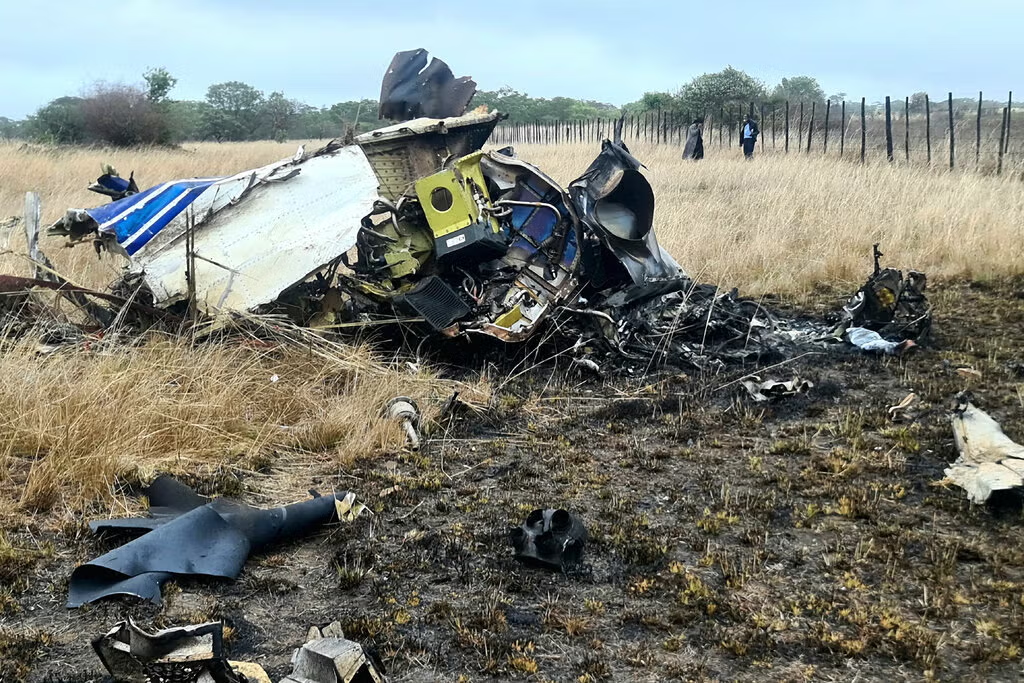
Serious questions have emerged over the investigation into the helicopter crash that killed controversial businessman Wicknell Chivayo, his wife Lucy Muteke, aide Senelisiwe Magagula and pilots Captain Kelvin Tafirei Soda and Courage Mutavirwa, following a startling contradiction in the official account of the recovery of the aircraft’s black box.
The preliminary investigation report released by the Ministry of Transport and Infrastructural Development states that the Bell 430 helicopter, registration Z-PED, which crashed at Kudenga Farm in Waddilove, near Marondera, on September 30, 2026, was fitted with a Cockpit Voice Recorder (CVR), but that the device was not recovered from the wreckage and is presumed to have been destroyed.
The revelation has cast a shadow over the investigation, particularly because it contradicts earlier public assurances by aviation authorities that the black box had been recovered intact. On October 1, barely 24 hours after the fatal accident, the Civil Aviation Authority of Zimbabwe (CAAZ), through its Director-General George Mashababe, confirmed that investigators had recovered the aircraft’s flight recording equipment.
The announcement was significant because the recorder was expected to provide crucial evidence about the final moments of the helicopter’s flight and help establish what caused the tragedy. Transport Minister Felix Mhona subsequently confirmed that international aviation experts had been brought in to assist with examining the wreckage and analysing the recovered recording equipment.
State broadcaster ZBC also reported that the black box had been found and would assist investigators in determining the circumstances surrounding the crash. As a result, the public was led to understand that investigators had secured one of the most important pieces of evidence in the accident.
The preliminary report’s assertion that the CVR was never recovered raises an obvious question: What exactly did authorities announce they had found on October 1, and what happened to that equipment?
This is not a minor technical discrepancy. It goes to the heart of the credibility, transparency and integrity of the investigation.
A black box that is supposed to survive extreme conditions
The missing CVR is particularly troubling because flight recorders are specifically engineered to survive catastrophic aviation accidents. Their protected memory components are housed in crash-survivable structures designed to withstand extreme impact forces, crushing pressure and intense heat. Depending on their certification and classification, flight recorder memory units undergo rigorous tests, including exposure to temperatures of approximately 1,100 degrees Celsius, severe impact forces and substantial crushing pressure. Some lightweight recorder systems designed for helicopters have different certification requirements from larger commercial aircraft recorders.
Nevertheless, their protected memory components are built to withstand conditions that would destroy much of the surrounding aircraft structure. This does not mean a flight recorder is indestructible. Exceptionally severe impacts, prolonged fires or other extraordinary circumstances can destroy even protected recording equipment.
However, its alleged destruction in the Chivayo helicopter crash requires a detailed technical explanation, particularly in light of the earlier announcement that recording equipment had been recovered intact. Investigators should disclose whether the missing CVR was physically identified at the crash site, whether it was ever handed over to investigators, and whether forensic examinations were conducted to establish its fate.
What would the missing recorder have revealed?
The Cockpit Voice Recorder is among the most important investigative tools in aviation accident inquiries. Unlike equipment that records technical flight parameters, the CVR captures cockpit conversations, pilot communications, radio transmissions and ambient sounds during the final period of a flight.
It can help investigators establish whether the pilots experienced an emergency, encountered unexpected mechanical problems, received warnings, discussed unusual flight conditions or attempted to respond to a developing crisis. Its recordings can also capture engine sounds, rotor abnormalities, alarms, warning signals, sudden changes in mechanical performance and other noises that may provide important clues about what happened.
In the Chivayo case, such evidence could have helped establish whether the crew encountered bad weather, suffered spatial disorientation, experienced mechanical failure or lost control of the helicopter. It could also have helped investigators reconstruct the sequence of events immediately before the aircraft struck the ground.
Without the CVR, an important source of evidence may be unavailable to investigators and the public.
The competing theories and unanswered questions
Several possible explanations have emerged regarding the September 30 accident.
These include adverse weather conditions, spatial disorientation, pilot error, loss of control in flight, mechanical or component failure and the possibility of deliberate interference.
Some believe bad weather may have contributed to the accident, while others suspect that foul play cannot be ruled out.
Political commentator Rutendo Matinyarare has added to the growing suspicions surrounding the circumstances of Chivayo’s death, suggesting that the businessman may have been deliberately targeted.
In a post on X, Matinyarare dismissed the suggestion that the crash was simply an aviation accident caused by bad weather, alleging that Chivayo’s death had been planned and executed by powerful individuals.
“There are still those who want to live in the make-belief that Wicknell died in an air traffic accident due to bad weather conditions. However, after the preliminary report has indicated that the fight recorder cannot be found, the truth is Wicknell’s death was planned and executed by very capable people because he stepped on the wrong toes. He was also neutralized to send a simple message: no one is untouchable. I warned him that he could lose his life but he didn’t listen and now the rest is history.”
Matinyarare’s remarks reflect suspicions circulating in some quarters, although he provides no evidence in the post to substantiate his allegation that the crash was deliberately orchestrated.
At this stage, none of the competing explanations has been conclusively established.
Nevertheless, the disappearance of the CVR, coupled with the conflicting official statements about its recovery, makes it imperative that investigators address the inconsistencies openly.
A tragedy that deserves answers, not unanswered contradictions
The preliminary report may eventually establish that the crash resulted from weather conditions, mechanical failure, pilot error or a combination of factors. It may also rule out deliberate interference. But the current contradiction over the black box raises questions that cannot simply be wished away.