

By Gabriel Manyati
On 6 November 2017, Robert Mugabe dismissed Emmerson Mnangagwa as Zimbabwe’s vice president, apparently believing he could remove a rival and regain control of the succession. Instead, he accelerated the collapse of his 37-year presidency.
Mnangagwa had powerful connections within ZANU PF and the security establishment. Grace Mugabe and the Generation 40 (G40) faction were challenging his political networks as the struggle to succeed the ageing president intensified. Mugabe underestimated the forces his decision would unleash.
On 15 November, the military intervened, placing Mugabe under effective house arrest while insisting it was targeting criminals around him rather than overthrowing the president. ZANU PF turned against Mugabe, mass demonstrations demanded his departure, parliament initiated impeachment proceedings and he resigned on 21 November. Mnangagwa returned from exile and was sworn in as president on 24 November.
The intervention was not an uncomplicated democratic revolution. It served the interests of powerful actors within the existing political establishment. But the outcome exposed Mugabe’s fatal miscalculation: he assumed that his authority over the party and state allowed him to dictate the succession.
Across Africa, presidents have repeatedly discovered that choosing an heir is not the same as controlling who eventually takes power.

When The Party Rebels
Thabo Mbeki learnt this in South Africa. In 2005, he dismissed Jacob Zuma as deputy president amid corruption allegations against Zuma. Mbeki remained national president, but the dismissal failed to extinguish Zuma’s political ambitions or his support within the African National Congress (ANC).
At the party’s Polokwane conference in December 2007, Zuma defeated Mbeki for the ANC presidency. Zuma was no longer Mbeki’s serving deputy, and victory in the party contest did not automatically make him national president. Nevertheless, it gave him a decisive advantage. Mbeki was recalled by the ANC in September 2008 and resigned as national president. Zuma assumed the presidency in May 2009.
Mbeki could exercise executive authority over Zuma, but he could not dictate the votes of party delegates who determined the ANC leadership. The party had become the battleground on which Mbeki’s succession preferences were defeated. The International Crisis Group’s analysis of Zimbabwe’s 2017 crisis similarly highlighted the danger of treating succession as a contest that an incumbent can settle unilaterally.
A decade later, Zuma encountered the same constraint. His preferred successor was widely understood to be Nkosazana Dlamini-Zuma, his former wife and a former African Union Commission chairperson. Cyril Ramaphosa, then the ANC’s deputy president, also contested the leadership.
At Nasrec in December 2017, Ramaphosa won by 2440 votes to Dlamini-Zuma’s 2261.
The result reflected competing provincial delegations, political networks and concerns about the ANC’s electoral prospects. Corruption controversies had weakened Zuma’s standing, while many party members feared the consequences of continuing under his leadership. Ramaphosa did not win simply because he was deputy president. He won because enough delegates preferred him to Zuma’s favoured candidate. When Zuma resigned under mounting internal pressure in February 2018, Ramaphosa succeeded him.
In both cases, the ruling party was not merely an instrument of the president. Its members had the power to reject his preferred political outcome.
When A Protégé Turns Against His Patron
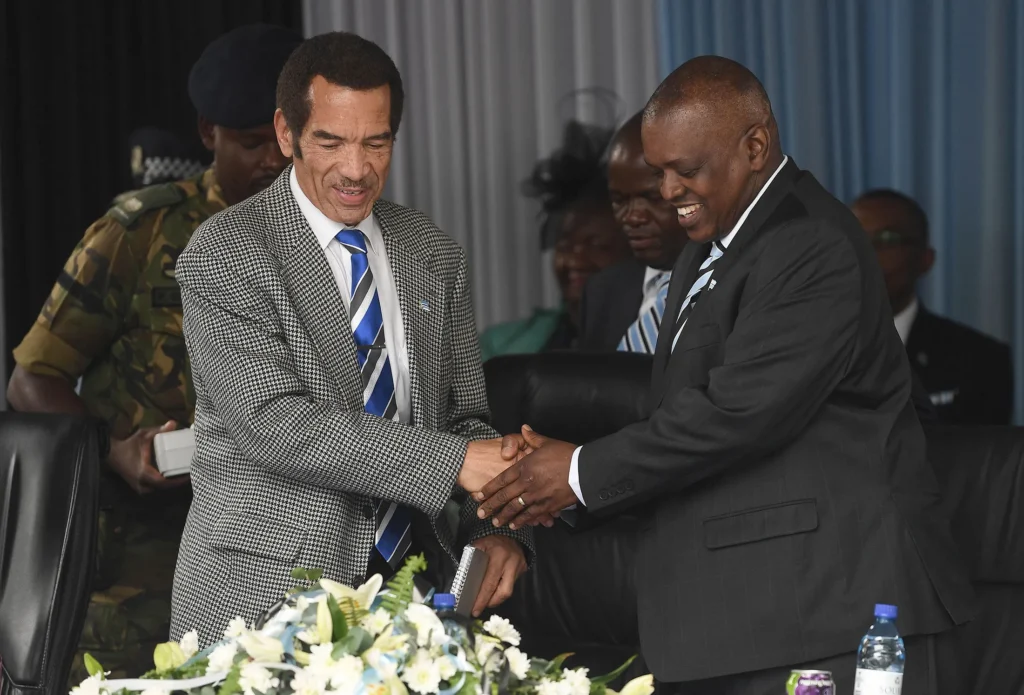
Botswana offers a different variation. Ian Khama helped position Mokgweetsi Masisi as his successor, and Masisi became president in April 2018 when Khama completed his term.
Their relationship later deteriorated. Khama turned against Masisi, broke with the Botswana Democratic Party and campaigned against him. Yet Masisi retained the presidency after the 2019 election. His political fortunes eventually reversed when the opposition won the 2024 election.
This was not a case of an incumbent initially trying to block his deputy’s succession. It illustrates how a president can help elevate a successor without ensuring that the successor will remain politically subordinate.
Kenya’s 1978 transition demonstrates a different constraint: constitutional succession. When Jomo Kenyatta died in office in August that year, Daniel arap Moi succeeded him constitutionally. Influential figures associated with the Kikuyu political establishment had tried to prevent Moi from taking over, including through efforts to alter the constitutional arrangements.
Kenyatta himself had expressed a preference for Moi, despite resistance from powerful members of his circle. Moi inherited the presidency, but he still had to build his own political coalition and weaken networks established under Kenyatta. The constitutional order protected his right to assume office when influential allies of the outgoing president sought a different outcome.
Malawi provided an even sharper test in April 2012. When President Bingu wa Mutharika died suddenly, his vice president, Joyce Banda, was constitutionally entitled to succeed him. Mutharika had previously marginalised Banda after their political falling-out, while members of the governing establishment favoured his brother, Peter Mutharika, as a possible successor.
After the president’s death, senior officials delayed publicly acknowledging it and challenged Banda’s right to assume office. Constitutional provisions, pressure to uphold the law and the political costs of openly bypassing them ultimately prevailed. Banda was sworn in as Malawi’s first female president.
The episode showed how political allies can attempt to control succession on behalf of a president, only to be frustrated by the constitutional order he leaves behind.
When Voters Reject The President’s Choice
Sometimes the decisive institution is neither the ruling party nor the military, but the electorate.
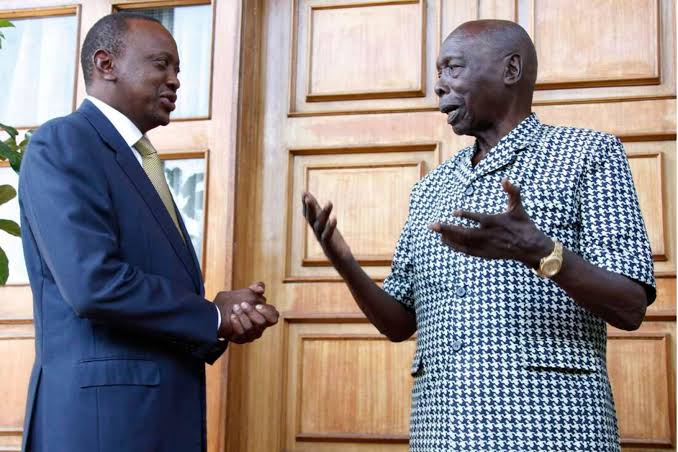
In Kenya’s 2002 election, Daniel arap Moi backed Uhuru Kenyatta as his preferred successor. Kenyatta was not Moi’s vice president; he was the candidate chosen to carry the ruling establishment into the next political era.
The electorate rejected the arrangement. Mwai Kibaki, leading the opposition National Rainbow Coalition, defeated Kenyatta decisively. Moi’s influence over the ruling party could not overcome voters’ determination to end KANU’s long hold on power.
A president may influence who becomes his party’s candidate, but he cannot necessarily determine whether that candidate wins a national election.
Not every succession project fails. Tanzania’s Julius Nyerere substantially influenced the transition to Ali Hassan Mwinyi when he left the presidency in 1985. Their orderly handover demonstrates that an outgoing leader can shape succession when party institutions and political interests align.
Political scientist Milan Svolik, in The Politics of Authoritarian Rule, identifies two fundamental challenges confronting authoritarian leaders: controlling the population and sharing power with the elites who help them govern. His analysis helps explain why accumulating authority does not eliminate the need to accommodate powerful allies. Succession brings that problem into sharp focus. Those who command party organisations, security institutions and political constituencies have interests of their own, and their loyalty may become conditional when an incumbent’s plans threaten those interests.
Mnangagwa And Chiwenga: The Stakes In Zimbabwe

Zimbabwe’s succession struggle brings these tensions into focus. Emmerson Mnangagwa and Constantino Chiwenga emerged from the 2017 transition as partners in the removal of Mugabe, but their positions within the political establishment were different.
Mnangagwa brought decades of experience in ZANU PF politics and state institutions. Chiwenga brought the authority and relationships of a former commander of the Zimbabwe Defence Forces, whose intervention had been decisive in ending Mugabe’s presidency.
That alliance did not settle who would eventually succeed Mnangagwa. Chiwenga’s position as vice president, military background and liberation-war credentials make him an important figure within the ruling establishment. Mnangagwa, meanwhile, has worked to consolidate his authority through party appointments, government structures and the management of competing political interests.
Neither man’s position guarantees victory. Military experience does not automatically translate into control of ZANU PF, just as command of party machinery does not guarantee the lasting support of every powerful institution.
The contest has become more consequential as Mnangagwa’s political future has been debated alongside machinations to extend his tenure beyond 2028.
In July, Mnangagwa signed the Constitution of Zimbabwe Amendment Bill (No. 3) into law. Among its provisions is the replacement of direct presidential elections with the election of the president by members of Parliament sitting jointly.
Such a change could alter the balance of power between voters, Parliament and the ruling party. A candidate able to command ZANU PF’s parliamentary majority could gain a substantial advantage. But that advantage would depend on the cohesion of the coalition behind him.
The October 2026 developments have sharpened the stakes. At its 23rd National People’s Conference in Chinhoyi, ZANU PF adopted resolutions endorsing Mnangagwa as its sole presidential candidate at the next party congress, aligning party leadership terms with the national Constitution and deferring the congress to 2029. The resolutions also directed the government to implement consequential legislative changes arising from Constitutional Amendment No. 3.
These decisions strengthen Mnangagwa’s immediate political position. They demonstrate the party leadership’s formal commitment to his continued leadership and to extending the political timetable beyond the previously expected transition.
But a party resolution does not settle the succession. The practical consequences depend on the applicable constitutional provisions, implementation of the resolutions, the legal status of the amendments and the political coalitions that emerge as the next congress approaches.
Mnangagwa faces two distinct objectives: extending his own tenure and determining who eventually succeeds him. Achieving the first would postpone the succession contest, not necessarily resolve it.
The additional time could allow him to strengthen allies, reorganise party structures and weaken challengers. It could also give rivals time to cultivate support and position themselves for a contest that cannot be postponed indefinitely. The outcome will depend on whether Mnangagwa can maintain a coalition capable of enforcing his preferred arrangement when the decisive moment arrives.
That requires the continued cooperation of party leaders, parliamentary representatives, security institutions and political networks whose interests will be affected by the transition. The Chinhoyi resolutions strengthen the incumbent’s hand, but they do not establish that Chiwenga has been permanently excluded, any more than his position as vice president establishes that he must eventually become president.
Mugabe’s experience is instructive, but history need not repeat itself. Mnangagwa is not Mugabe in every respect, and Chiwenga’s position differs from Mnangagwa’s in 2017. Zimbabwe’s political and constitutional circumstances have also changed.
Nevertheless, the underlying dilemma remains. An incumbent can remove a rival from office without eliminating his networks. He can secure a party resolution without guaranteeing the lasting support of every important actor. And he can change the rules only to the extent that the institutions responsible for implementing them allow.
Mnangagwa knows what happened when Mugabe tried to remove him from the succession. He benefited from the failure of a president who believed he could settle the matter by dismissing his rival.
Now, as Zimbabwe debates the extension of Mnangagwa’s tenure and the future of Chiwenga, the decisive question is whether the president can secure the lasting support of the institutions and political forces that will determine what happens next.
The presidency gives a leader immense power to shape the succession. It does not give him ownership of the future. He can nominate an heir, weaken rivals and rewrite the rules. But when the decisive moment arrives, other people must accept the arrangement. That is when the president discovers whether he has chosen a successor or merely announced a preference.



