Business Correspondent
Trade among Common Market for Eastern and Southern Africa (COMESA) member states accounted for just 6.9 percent of the bloc’s total merchandise exports in 2024, exposing a significant gap between regional economic integration ambitions and actual trade performance despite a combined economy valued at approximately US$1.23 trillion.
The figures underscore the challenges facing the 21-member bloc, which represents a market of more than 640 million people but continues to struggle with trade barriers, limited industrial production and slow economic integration.
According to previously COMESA trade figures, intra-regional merchandise exports amounted to approximately US$14 billion in 2024, against total merchandise exports of US$202 billion.
The performance was substantially below COMESA’s previously announced target of increasing intra-regional exports to at least 25 percent of total exports by 2026, raising questions about the effectiveness of regional trade policies and efforts to unlock the bloc’s economic potential.
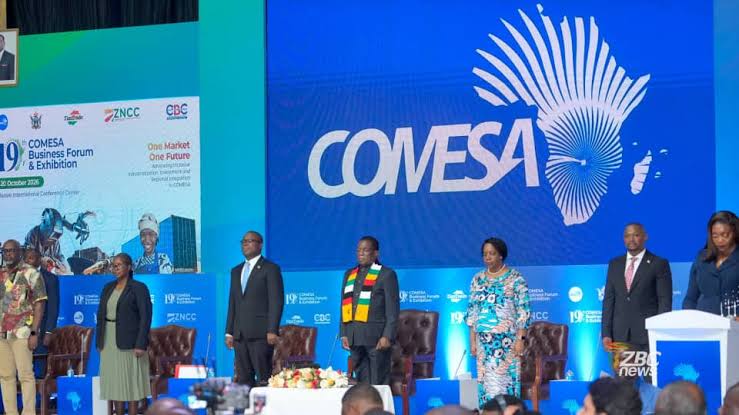
Addressing the 19th COMESA Business Forum in Harare on Tuesday, President Emmerson Mnangagwa acknowledged the region’s weak internal trade performance and challenged governments and businesses to tackle longstanding obstacles restricting cross-border commerce.
“Intra-COMESA trade and investment remain significantly low. This gap presents both a challenge, as well as an opportunity,” Mnangagwa said.
He urged delegates to move beyond policy commitments and pursue practical solutions to increase regional trade, attract investment and create employment.
Zimbabwe’s export performance reflects both the opportunities and limitations of regional integration.
According to figures reported by national trade promotion agency ZimTrade, Zimbabwe’s exports to COMESA increased by approximately 10.4 percent, from US$201 million in 2024 to US$222 million in 2025.
Despite the growth, the figures remain modest relative to the size of the regional market, highlighting the need for greater industrial production, export diversification and stronger distribution networks.
Mnangagwa identified non-tariff barriers, lengthy customs procedures, complex rules of origin and high business costs as major obstacles undermining regional trade.
He called for improved transport corridors, simplified border procedures and stronger infrastructure to facilitate the movement of goods and reduce operational costs.
“Our borders are gateways to markets and not bottlenecks to trade,” he declared.
The President cited Zimbabwe’s modernisation of Beitbridge Border Post and the upgrading of Chirundu One-Stop Border Post as examples of infrastructure investments aimed at improving regional connectivity.
However, persistent trade barriers continue to raise questions about whether such investments and existing trade agreements are delivering lower business costs, faster customs clearance and increased trade volumes.
Mnangagwa also challenged regional economies to reduce their dependence on raw commodity exports and prioritise industrialisation, manufacturing and mineral beneficiation.
“Private sector players are urged to move decisively from the export of commodities towards value addition, beneficiation and manufacturing,” he said.
He cited Zimbabwe’s December 2022 restrictions on exports of unprocessed lithium ore as part of efforts to promote domestic mineral processing and retain greater value from the country’s natural resources.
Agriculture, mining, energy, pharmaceuticals, battery materials and clean-energy technologies were among the sectors identified as offering significant regional investment opportunities.
Mnangagwa urged businesses to develop interconnected production networks capable of strengthening regional supply chains rather than pursuing isolated national projects.
“Investments in our respective jurisdictions should not be developed as isolated national projects. They must connect our economies through mutually beneficial cross-border investments and regional value chains,” Mnangagwa said.
He also called for stronger productive capacity, the removal of tariff and non-tariff barriers and harmonised trade procedures to maximise opportunities under the African Continental Free Trade Area.
Access to affordable financing remains another major obstacle, particularly for small and medium-sized enterprises seeking to expand into regional markets.
Mnangagwa acknowledged these financing constraints and called for closer cooperation between governments, financial institutions and private investors to unlock capital for industrial development.
He challenged participants to translate the forum’s discussions into commercially viable partnerships linking producers, manufacturers, investors and small businesses with regional markets.
The business forum forms part of high-level COMESA engagements taking place in Harare from October 19 to 22.
Proceedings began on Monday with the COMESA Green Industries Connect initiative, focusing on sustainable industrialisation, investment and regional production networks.
Tuesday’s 19th COMESA Business Forum brought together business executives, investors, policymakers and financial institutions to discuss trade facilitation, industrialisation, financing and digital transformation.
A Multi-Sectoral International Exhibition, running from October 19 to 21, is also showcasing products, innovations and investment opportunities from across the region.
On Wednesday, October 21, COMESA Ministers of Foreign Affairs are meeting at the New Parliament Building in Mount Hampden, west of Harare, ahead of the main summit.
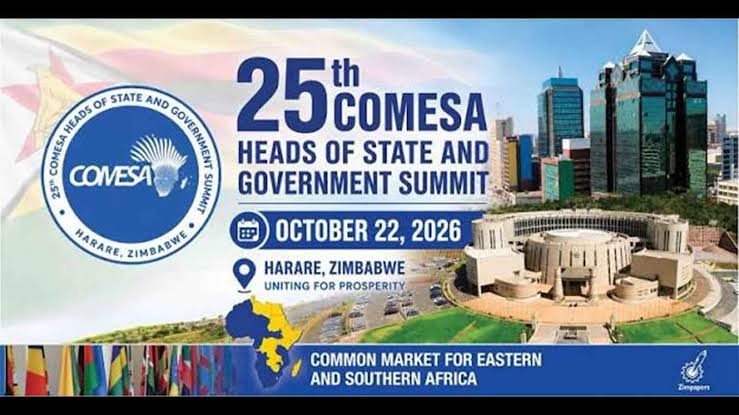
The programme will culminate on Thursday, October 22, with the 25th COMESA Summit of Heads of State and Government at the same venue, where Zimbabwe will formally assume the bloc’s rotating chairmanship from Kenya.
The summit is also expected to consider the COMESA Medium-Term Strategic Plan for 2026–2030, which prioritises industrialisation, infrastructure development, digital transformation and deeper regional economic integration.