Midlands Correspondent
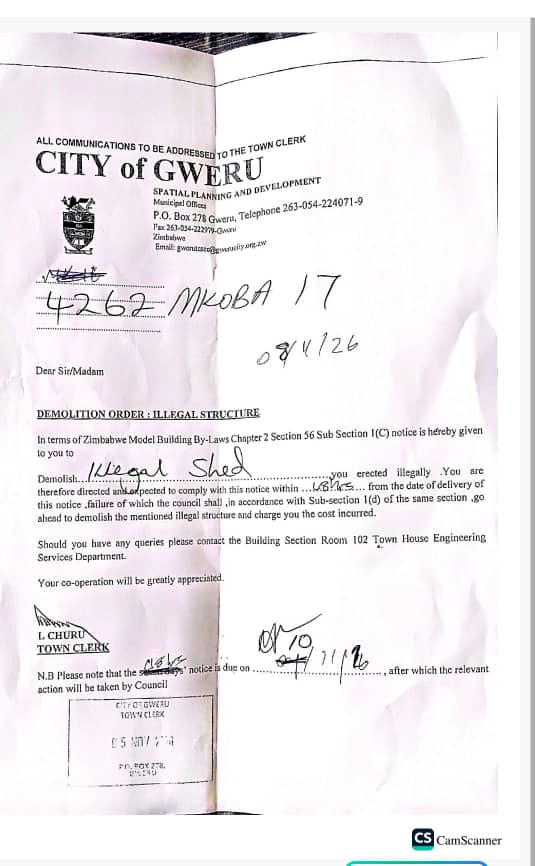
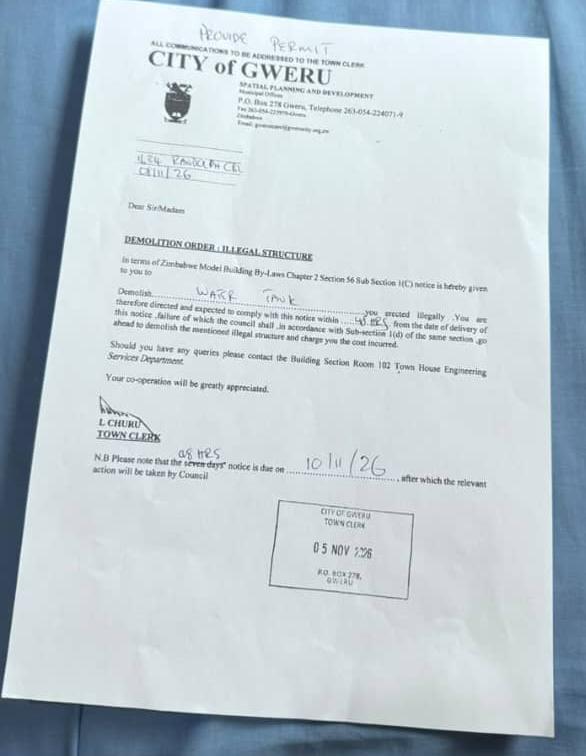
GWERU- Fear, panic and uncertainly have gripped Gweru as residents face a 48-hour ultimatum to demolish structures deemed illegal or risk having them torn down by the city council, which has launched a sweeping crackdown on unauthorised developments and informal trading across the city.
While the council maintains that the operation is necessary to restore order and protect public infrastructure, residents and civic groups are calling for a more consultative and differentiated approach, particularly where structures have been erected within private residential properties.
The enforcement exercise, being conducted under Operation Chenesa Gweru, targets structures erected on road reserves, designated open spaces, areas reserved for public utilities and other spaces not approved for construction.
Since last week, affected property owners have been receiving notices ordering them to remove the structures within 48 hours, failing which council says it will carry out demolitions and recover the costs from the owners.
The operation has, however, sparked concern among residents and civic organisations, with questions being raised over the manner in which the exercise is being conducted and whether all targeted structures genuinely warrant demolition.
Speaking during a full council meeting, Gweru Mayor Councillor Martin Chivhoko defended the operation, saying it was necessary to restore order, protect public health and reclaim public spaces.
“This operation is not a war on livelihoods. It is a necessary intervention to ensure order, to protect public health, and to reclaim spaces that belong to everyone,” said Chivhoko.
He added that traders operating outside designated trading zones would be given an opportunity to relocate to approved trading sites.
However, the enforcement of the regulations has drawn criticism from the Gweru United Progressive Residents and Ratepayers Development Association (GUPRARDA), whose executive director, David Chikore, questioned the targeting of JoJo water storage tanks installed in residential yards.
Chikore argued that residents had resorted to installing water tanks because of unreliable municipal water supplies, questioning why households should be punished for trying to secure access to water.
“What crime have JoJo tanks committed that they have to be demolished in people’s yards in Senga and Mkoba? Have you asked yourselves why residents have these tanks? Before independence, you would not see any water storage containers in people’s yards because the council could provide water 24/7,” he said.
He said residents were already enduring numerous service delivery challenges, including poor roads, inadequate street lighting, dysfunctional drainage systems and sewage problems.
“The issue is not only water. Our roads are potholed throughout, there are no street lights, drainage is non-existent and we are used to flooded homes. Sewage is all over and we are not complaining. We have endured silently,” Chikore said.
He also questioned the continued reliance on old municipal by-laws, arguing that some regulations being enforced date back to the colonial era and should be reviewed to reflect the country’s current socio-economic realities.
“Forty-six years into independence, you are enforcing 1972 by-laws formulated during the colonial era, designed to restrict black people from living in urban areas. Why are you fighting your own people when the country has a high rate of unemployment?” he asked.
Meanwhile, Gweru United Residents Association (GURA) director Reward Mhuri called for a more flexible approach, arguing that council should distinguish between structures occupying public spaces and those erected within privately owned residential properties.
Mhuri said some developments, particularly permanent structures within residential yards, could be considered for regularisation instead of being subjected to automatic demolition.
He noted that regularisation would allow council to bring such developments into its planning system while generating revenue through the collection of applicable fees and charges.
“The issue of illegal structures is a bit challenging because, of course, there are illegal structures that are permanent like tuck shops that might even tarnish the city’s image. But if these are within yards, I think they should just be regularised and enable the local authority to get revenue,” he said.