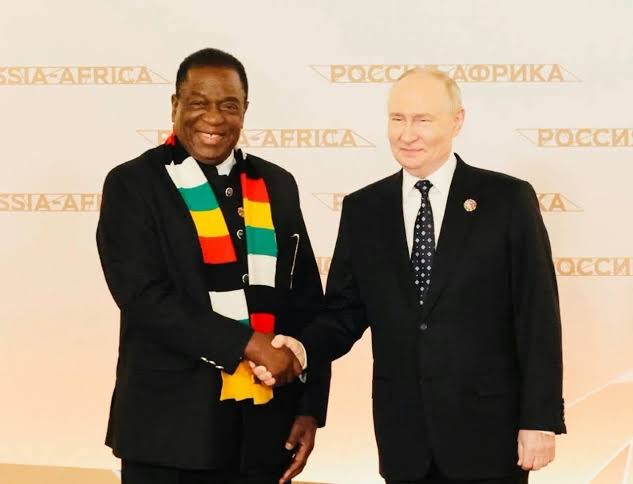
Key Takeaways:
- The third Russia-Africa Summit in Moscow, attended by leaders from 48 countries, highlighted Moscow’s push to expand economic and humanitarian cooperation, diversify export markets for grain, fertilizers and technology, and strengthen multipolar partnerships amid global tensions.
- Putin reported Russia-Africa trade exceeding $27 billion with a goal of doubling it, noted that more than 40 African states receive Russian grain and fertilizer, and outlined cooperation in energy, mining, digital technologies, education (40,000 African students in Russia) and debt relief.
- The summit advanced a 2027–2029 partnership action plan and deeper ties with African regional organizations, while African Union Chair Évariste Ndayishimiye emphasized African solutions to African problems and mutually beneficial cooperation.
Russia-Africa Summit highlights Russia’s continuing pivot to Africa, with an agenda to expand broadly an economic cooperation. It also reflects its Moscow’s strategy of diversifying export destinations, prioritising the African market for its agricultural products and fertilisers and technology, amid the rapidly growing geopolitical tensions and uncertainty in global markets.
Russian President Vladimir Putin, took part in the plenary session of the Russia-Africa Economic and Humanitarian Forum held at Gostiny Dvor in Moscow. Chairperson of the African Union, President of the Republic of Burundi Évariste Ndayishimiye also delivered an address. The session was moderated by Director of the Russian Academy of Sciences Institute for African Studies, Professor Irina Abramova.
Since first meeting in Sochi in 2019, Russian-African cooperation has stood the test of time and acquired a strategic character. Today, Russia is identifying the key areas of interaction in the economic and humanitarian sphere, which will strengthen sovereignty, reinforce the positions of Africa and Russia on the international stage, contribute to the effective implementation of national and regional development strategies of Russia and Africa and, of course, make the lives of both Russian and African peoples safer, more harmonious and more prosperous.
Key Points of the Speech of H.E. Mr. Vladimir Putin, President of Russia, at the Russia–Africa Economic and Humanitarian Forum, on 28 October 2026. It was part of the third Russia-Africa Summit in Moscow, a two-day event attended by African leaders and government delegations from 48 countries. According to official records, monitored by The Diplomatic Society, Putin simultaneously held one-on-one talks with many of the 22 individual African leaders attending on issues such as trade, security, arms and grain.
*The emergence of a multipolar world is an objective and irreversible process. Africa is increasingly asserting itself as one of the poles of the global economy and politics, strengthening its sovereignty and seeking to determine its own development path.
*BRICS is becoming a key center of the new world order. Over the past five years, its member states have produced more than 40% of global GDP, while the G7 accounted for less than 30%.
*The colonial legacy and neo-colonial practices remain serious obstacles to Africa’s development. These include illegitimate sanctions, tariff wars, economic dictate, debt dependence, and interference in internal affairs.
*Russia supports the financial recovery of African states, debt relief, and reform of international financial institutions in line with the interests of developing economies.
*Technological sovereignty is becoming the foundation of the modern economy and public administration. Russia is ready to share expertise with African partners in digital platforms, artificial intelligence, cybersecurity, and data storage.
*Russia–Africa trade exceeded $27 billion and should at least double to more than $50 billion. Russia remains a reliable food supplier: more than 40 African states receive Russian grain and fertilizer.
*Cooperation covers energy, mining, water management, transport, and finance. More than 30 energy projects are being implemented in 16 African countries; proposals include local processing of raw materials, modern logistics, and settlements in national currencies.
*Humanitarian cooperation is expanding: about 40,000 African students study at Russian universities, and the scholarship quota for 2026–2027 has been increased to 5,500 places. The sanitary and epidemiological assistance program has been extended to 2029.
*The summit is expected to adopt the Russia–Africa partnership action plan for 2027–2029 and present a platform for the sovereign development of African states.
On the sidelines of the Russia–Africa Summit, Putin also had a meeting with the heads of leading regional organisations on the African continent. In attendance were Secretary General of the Commonwealth of Independent States, Sergei Lebedev, and Chair of the Eurasian Economic Commission’s Board, Bakytzhan Sagintayev.
There were representatives from the African Union, the African Continental Free Trade Area, the Arab Maghreb Union, the Common Market for Eastern and Southern Africa, the East African Community, the Economic Community of West African States, the Economic Community of Central African States, the Southern African Development Community, the Intergovernmental Authority on Development and the African Export-Import Bank.
While exchanging views, in greater detail, on the multilateral dimension of the Russia–Africa dialogue, Putin described these steps as the bedrock for collaborating and consolidating connectivity with African states in trade, investment, science, education and youth policy.
The general interpretation was that strengthening relations with pan-African associations is a natural continuation of a long-term policy aimed at maintaining an equal and mutually beneficial partnership with African states.
In this direction, the African Union is considered as Russia’s key partner among regional organisations, in carrying out a three-year roadmap, focusing on cooperation in trade and economics, research and technology, social, humanitarian and cultural affairs, as well as on political and security matters.
Russia has already launched sectoral dialogues between Russian agencies and respective commissions of the African Union, targeting issues relating to the pan-African payment and settlement system created by the AU and the Afreximbank.
Further to that, Russia has, unreservedly, welcomed the African Union’s desire to join the Group of 20 as a full member, underlining as one more step to ensure a fairer representation for Africa in multilateral organisations, and on international platforms.
According to reports, the EAEU operates a unified system of tariff preferences, offering African exporters significant advantages, when exporting their goods to Greater Eurasia Union’s markets. Forty-seven nations across the continent benefit from this system, 32 of them with a complete exemption from customs duties. The Commonwealth of Independent States (CIS) and the Eurasia region, the two most influential regional blocs, constitute certainly a huge potential for African nations.
Chairperson of the African Union and President of Burundi, Évariste Ndayishimiye, in remarks, noted positive results since Sochi in 2009 and St Petersburg in 2023. Referring to several measures toward advancing cooperation, Ndayishimiye emphasized the African continent, with estimated 1.5 billion people, as a huge consumer market. Beyond that, Africa would like to see a transformation and refinement of regional chains, better access to transport corridors, and more advances in healthcare and culture.
“We adhere to the principle of African solutions to African problems, Africa supports a balanced and mutually beneficial partnership,” Ndayishimiye asserted in closing remarks.
The Russia-Africa Summit, was first held in 2019, as a landmark step of a concerted push for Russian political, economic and military influence on a continent where paramilitary fighters from Russia’s Africa Corps remain active. It was followed by another Summit in St. Petersburg in July 2023.

About Kester Kenn Klomegah
Kester Kenn Klomegah is an independent researcher and a policy consultant on African affairs in the Russian Federation and Eurasian Union. He has won media awards for highlighting economic diplomacy in the region with Africa. Currently, Klomegah is a Special Representative for Africa on the Board of the Russian Trade and Economic Development Council. He enjoys travelling and visiting historical places in Eastern and Central Europe. Klomegah is a frequent and passionate contributor to Eurasia Review.