You cannot measure the pulse of a ghost
By Tendai Ruben Mbofana
The recent announcement by the Zimbabwe National Statistics Agency declaring that annual ZiG inflation stood at 4.3% in October 2026 has been met with celebration in official circles.
State media and government officials present this as a victory. They position the current single-digit inflation figures as historic lows not seen in decades.
Behind these statistical victories lies an uncomfortable economic reality.
The official narrative relies on a mathematical illusion built upon a currency that most ordinary Zimbabweans rarely hold in their hands.
To understand this disconnect, we must examine the structural realities of our economy. Inflation measures the rate at which money loses purchasing power over time.
When a currency is virtually absent as physical cash, its velocity and market-clearing pricing mechanism are artificially restricted.
You cannot claim price stability for a currency that citizens cannot touch, hold, or spend naturally. Its stability is a product of supply suppression rather than organic market equilibrium.
The citizens primarily transacting in ZiG do not do so out of consumer preference. Civil servants, pensioners, and formal sector workers receive their wages in electronic bank balances.
Because access to cash withdrawals is severely capped, these funds exist almost purely as digital balances.
This creates a captive market where workers are forced to offload electronic ZiG immediately before it loses value, distorting true demand signals.
A currency’s health is measured by its utility as a medium of exchange.
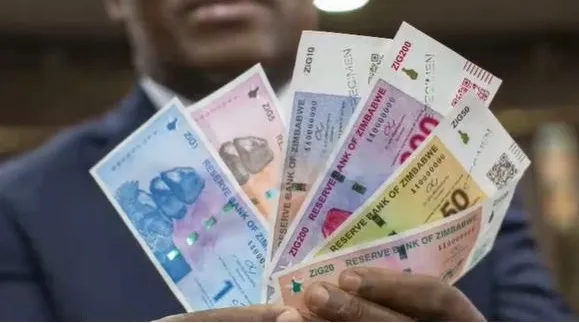
In retail stores across Zimbabwe, shops lack physical ZiG banknote change. Customers are routinely forced to accept unwanted items like sweets or biscuits in lieu of change.
Alternatively, they receive change in South African rands or in rare cases, Botswana pula.
A currency that fails in its fundamental role as a unit of change cannot be held up as a functioning success story.
Even by official figures, the ZiG accounts for only roughly 43% of total national transactions.
The remainder is conducted in foreign currency, predominantly the US dollar. Crucially, this 43% share is largely involuntary.
It is driven by statutory obligations such as taxes, utility payments, and mandatory payroll conversions.
In a truly competitive currency market without state mandates, natural consumer usage of the ZiG would drop to negligible single digits.
The US dollar remains the true lifeblood and pricing anchor of Zimbabwe’s economy.
Businesses set baseline costs, import raw materials, and index prices in US dollars, then convert to ZiG at prevailing rates.
Without the greenback absorbing economic shocks, providing import liquidity, and acting as the real store of value, the ZiG would be directly exposed to market forces and its real purchasing power tested.
The authorities recognize that fully demonetizing or removing the US dollar would instantly collapse the fragile trade balance and retail supply chains.
The multi-currency framework acts as an artificial shock absorber.
By maintaining the dual system, the government relies on US dollar transactions for real value while using the controlled ZiG ecosystem to claim statistical wins.
That is why the government will never do away with the greenback anytime soon.
Comparing today’s metrics to historical eras is fundamentally flawed.
In the 1980s and 1990s, the Zimbabwe Dollar was a fully fledged, widely circulating legal tender backed by a strong agricultural and manufacturing base.
It was used by everyone, across all socio-economic strata, for every transaction.
Today’s single-digit inflation is achieved within a heavily managed, highly restricted digital-currency enclave nested inside a dollarized economy.
Comparing the ZiG to the 1990s dollar is akin to comparing a toy car on a smooth table to a truck carrying heavy cargo down a ruined road.
One is artificially sheltered from any real friction or weight, while the other is subjected to the true elements of survival.
While official reports present low inflation numbers as a sign of economic recovery, lower inflation metrics mean little when prices remain out of reach for ordinary citizens whose incomes do not match living costs.
True monetary stability is felt in pockets, seen in available change at checkouts, and measured by voluntary public trust.
None of these exist for a constrained, mostly electronic ZiG.
- Tendai Ruben Mbofana is a social justice advocate and writer. Please feel free to contact him on +263715667700 or mb*******************@***il.com