Joseph Kabila’s decision to lead a new political-military movement is the latest development in a crisis that has deepened since Félix Tshisekedi came to power. The attempt to isolate— and, in the eyes of his supporters, eliminate—the former president politically may have helped turn a former political partner into a direct challenger to the regime that sought to
marginalize him.
By Albert Rudatsimburwa
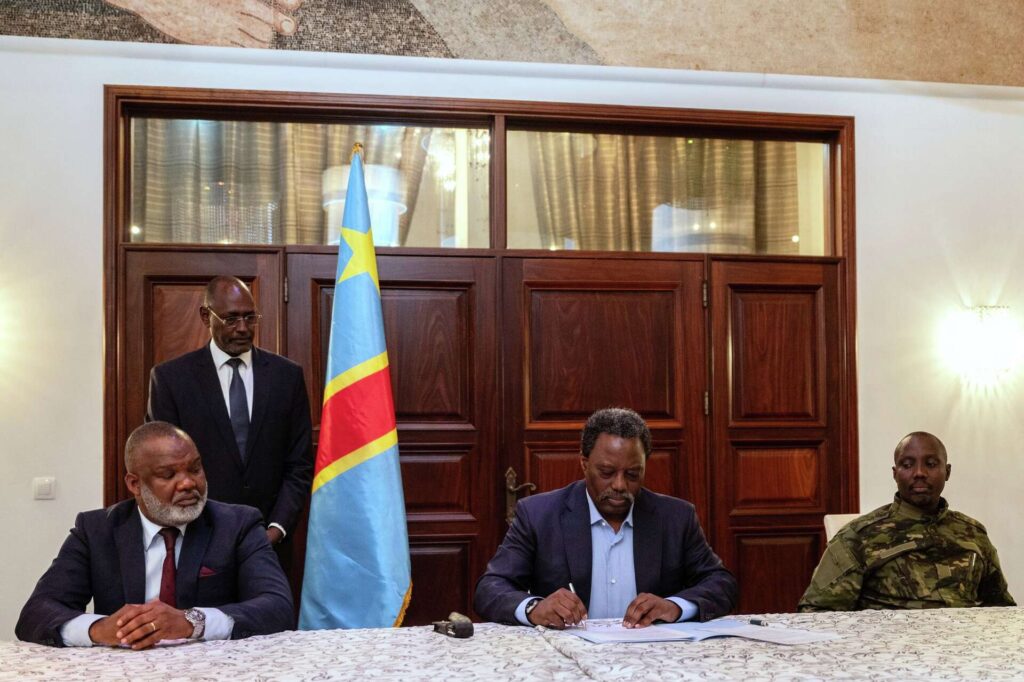
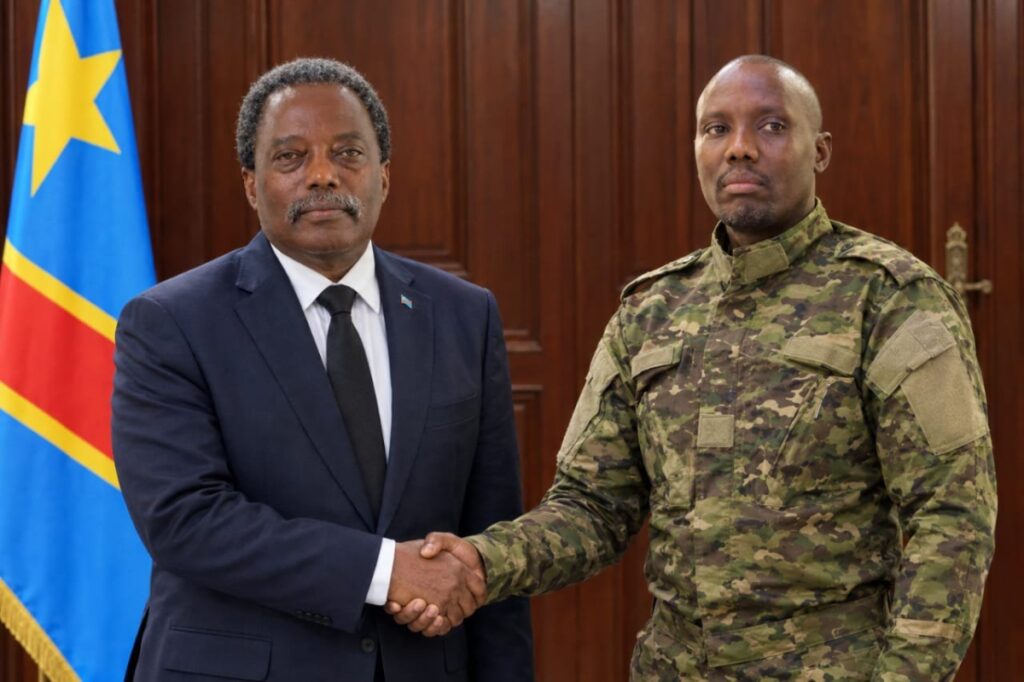
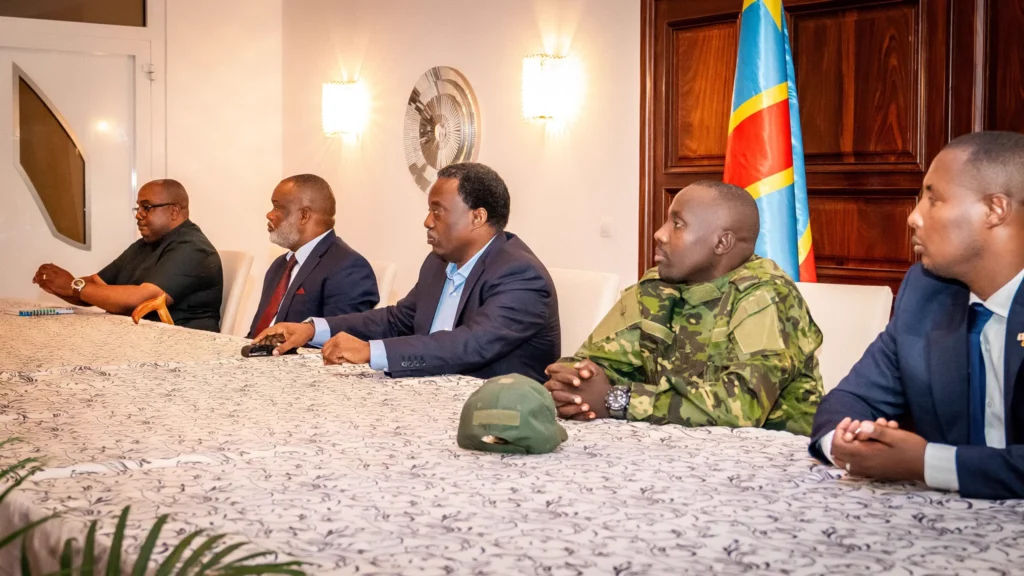
On 12 October 2026, Joseph Kabila made a decision that changes the political equation in the Democratic Republic of Congo. In Goma, he announced the creation of the Front pour la Refondation de la Nation (FRN), a new political-military movement incorporating leading figures from the former Alliance Fleuve Congo (AFC) and M23 coalition. Corneille Nangaa, Bertrand Bisimwa, Freddy Kaniki and military commander Sultani Makenga are among its leading figures. The movement describes itself as a political-military front intended to unite resistance forces and restore the Congolese state, including through the use of force.
The announcement is consequential, but its significance goes beyond the emergence of another armed movement in a country already exhausted by conflict. It raises a more fundamental question: how did the political conditions in Congo evolve to the point where a former president, who had remained largely outside the unfolding confrontation for years, would return openly to lead a political-military coalition against his successor?
Kabila’s decision should not be viewed in isolation, nor should it be taken as proof that every claim he makes about his intentions is justified. It must be examined against the political history that preceded it: the contested transition of 2018, the deterioration of governance under Félix Tshisekedi, the resurgence of conflict in the east, the increasingly personal confrontation between the incumbent president and his predecessor, and, finally, Washington’s decision to impose sanctions on Kabila.
The central argument is that his return may be less a story of a former president suddenly seeking power again than the consequence of a political strategy that progressively made his continued withdrawal harder to sustain. The attempt to isolate him through political condemnation, legal proceedings and international sanctions may have helped turn a former president into a direct challenger to the very order that sought to exclude him.
The bargain of 2018 and the promise of stability
The circumstances of Tshisekedi’s accession to power have never entirely disappeared from Congolese politics.
The December 2018 elections came at the end of a tense political period. Joseph Kabila was leaving office after an extended and deeply contested tenure, while the country faced the prospect of another destabilizing confrontation over the succession. The official results declared Félix Tshisekedi the winner. But the outcome was disputed from the beginning. Martin Fayulu challenged the result, while Catholic Church tallies and leaked voting data raised serious questions about whether the announced result reflected the votes cast.
The African Union initially called for the suspension of the proclamation of the final results, citing serious doubts about whether the provisional results reflected the votes cast. After the Constitutional Court confirmed Tshisekedi’s victory, however, the African Union Commission took note of the final results and urged Congolese actors to preserve peace and stability.
That sequence matters. The region had reason to fear that a confrontation over the election could destabilize a country whose internal crises had repeatedly drawn its neighbors into war. A peaceful transition was a legitimate concern, even as the credibility of the electoral outcome remained contested.
One interpretation of the political calculation at the time is that Tshisekedi appeared to offer a compromise. Despite his family’s long opposition to Mobutu and the political establishment, he might have been seen as less personally invested in settling scores with Kabila than some of the other contenders. He had inherited a major political name and the leadership of the opposition UDPS, but he had spent much of his adult life in Belgium and had limited experience of government or state administration.
The expectation, in this reading, was that he might concentrate on governing, rebuilding institutions and preserving stability rather than opening a new cycle of political confrontation. The overriding objective was to avoid another crisis that could destabilize not only the DRC but the wider Great Lakes region.
What followed has exposed the limits of that expectation.
From a promise of peace to a permanent crisis
Tshisekedi came to office promising transformation and development, alongside the elimination of armed groups in eastern Congo. Yet the conflict he inherited was not simply a security problem caused by a collection of militias. It was also a political problem whose roots had repeatedly been deferred rather than resolved.
M23 was not conducting an active rebellion when Tshisekedi began his presidency, but its political grievances remained unresolved. Those grievances were not unknown to the new president: representatives of the movement had been in contact with his camp during the run-up to the 2018 elections.
When M23 withdrew from Goma in 2013, following its defeat and the ensuing negotiations, its grievances were supposed to be addressed through a political process. That process was never properly carried through and did not deliver a settlement accepted by all the relevant parties. The movement was weakened and largely absent from the battlefield for several years, but the underlying political questions remained unresolved.
The distinction between defeating an armed organization and resolving a conflict is fundamental. A movement can be driven from the battlefield without the grievances, fears and political disputes that sustained it having disappeared
Tshisekedi inherited that problem. In the early years of his presidency, channels of communication with M23 representatives remained open, including discussions about the movement’s possible place in a reorganization of the national army. Accounts subsequently published by people familiar with the negotiations describe an M23 delegation invited to Kinshasa in 2020 that remained there for fourteen months. The discussions reportedly included the future of the movement’s combatants and a possible reorganization of the FARDC (Forces armées de la République démocratique du Congo).
After presenting proposals, the delegation was sent back to its base in North Kivu, reportedly with instructions to wait for further notice. Whatever the precise details of those discussions, the essential question remains: why did a political channel that had once existed fail to produce a lasting settlement?
In May 2021, two years into his presidency, Tshisekedi declared a State of Siege in North Kivu and Ituri. Civilian provincial authorities were replaced by military and police officials in an effort to restore security. The president presented the measure as a means of bringing an end to the violence and even declared his determination to remain in Goma until peace returned to the east.
The results fell far short of those promises. The military administration did not bring the conflict to an end. At the time, the number of armed groups operating across the Kivus was commonly estimated at around 28, alongside the grave insecurity affecting Ituri. These groups had different origins, constituencies and objectives; they could not be treated as one uniform enemy to be defeated through a single military strategy.
Then came the decision to turn the military effort against M23.
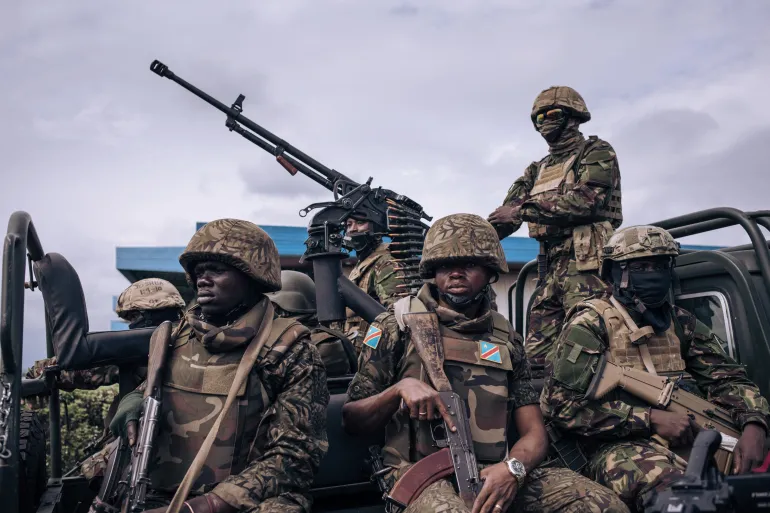
The reasoning, as understood by those who followed the developments, was that M23 had become weak, unequipped and isolated after years without sustained combat and could be defeated decisively. A victory over a movement widely portrayed as associated with Rwanda could also have served as a political demonstration of strength. But the continued attempts to eliminate M23 militarily turned into a serious defeat for the Congolese army. The movement recovered its fighting capacity, attracted through multiple victories more local youth to join and began advancing, village by village and hill by hill, eventually taking Bunagana, a border town between the DRC and Uganda.
That reversal was a turning point. Rather than prompting a fundamental reconsideration of the political approach, the government’s response increasingly placed military defeat of M23 at the center of its strategy.
The perception of M23 as a force associated with Rwanda became a dominant part of the political narrative, even though Tshisekedi himself had previously acknowledged that M23 was a Congolese movement. The implications were serious. Once the conflict was treated primarily as external aggression, the political demands of Congolese actors in the east could be sidelined. If victory over an allegedly foreign-backed enemy became a source of political legitimacy, the government had an incentive to persist militarily even as the conflict spread and its costs increased.
The result has been a deepening crisis in eastern Congo, repeated regional interventions and the enlargement of the political constituency opposed to Kinshasa. M23’s transformation into AFC/M23 brought together military and political actors beyond the original movement. Corneille Nangaa, the former head of the electoral commission who oversaw the disputed 2018 election, became one of its most prominent political figures.
A conflict that might have been addressed through political negotiations had become a much wider confrontation over the authority and legitimacy of the Congolese state.
From political opponent to personal enemy
Meanwhile, the relationship between Tshisekedi and Kabila deteriorated into an increasingly bitter confrontation.
Kabila’s political position was progressively weakened. His properties and personal wealth came under pressure, and the former president had reason to fear for his physical security. In 2025, he travelled to Goma, a city then under AFC/M23 control, where he had properties and where he could still operate within the DRC. His political opponents interpreted his presence there as evidence of an alignment with the rebellion; his supporters presented it as an attempt to engage with the crisis and find a way out of it.
The confrontation entered a new phase when Kabila faced legal proceedings in absentia. In September 2025, a Congolese military court sentenced him to death after convicting him on charges including treason and participation in an insurrection. Kabila denied wrongdoing and argued that the proceedings were politically motivated.
The proceedings also brought the former president’s nationality into question. Lawyers representing civil parties argued that he was of Rwandan origin, had been adopted by Laurent-Désiré Kabila and had assumed a Congolese identity. The military court did not itself rule that Kabila was not Congolese; it declared itself incompetent to decide the nationality question and referred the matter to the government. Nevertheless, the attempt to cast doubt on the nationality of a man who had served as president of the DRC for eighteen years became a striking feature of the case.
For Kabila and his supporters, the proceedings represented much more than an effort to hold a former head of state accountable. They appeared to mark an attempt to remove him from the political landscape altogether: his immunity was lifted, his political position was attacked, his nationality was questioned and a death sentence was pronounced while he was absent from court.
There is a point at which the exclusion of a political opponent ceases to be merely a means of consolidating power and begins to create a new political problem. The more completely an opponent is denied room to operate within the existing system, the greater the incentive to seek a way to challenge that system from outside it.
That is not a justification for taking up arms. It is an explanation of why political exclusion, particularly when it is perceived as threatening a person’s physical survival, can have consequences far beyond those its architects intended.
The American sanctions: a turning point
The decision by the United States on 30 April 2026 to sanction Kabila was a decisive new element in this confrontation.
The US Treasury accused the former president of supporting AFC and M23, including through financial assistance, encouraging defections from the Congolese army, attempting to organize attacks against government forces and seeking to install a political figure opposed to Tshisekedi. Washington said the sanctions were intended to hold Kabila accountable for his role in supporting the armed coalition.
These were serious allegations. But the public designation did not provide the underlying evidentiary material in a form that allowed independent observers to examine it and assess its strength. The announcement set out the US government’s conclusions; it was not a public judicial proceeding in which the allegations were tested against evidence and a defense.
Kabila had travelled to Goma in 2025, before the American sanctions were imposed. His presence in rebel-held territory was politically significant, and suspicions about his relationship with AFC/M23 were already circulating. But his presence in Goma did not, by itself, establish every allegation subsequently made by Washington. Nor does the fact that he had not openly declared an alliance before October 2026 prove that no private relationship existed.
There was also a security dimension to his decision to remain in Goma. It was one of the few places inside the DRC where he still had properties and could remain outside the direct reach of the government in Kinshasa. In March 2026, a drone strike in the city killed Karine Buisset, a French UNICEF aid worker, at a residence near Kabila’s home. AFC/M23 blamed Congolese government forces, but responsibility for the attack had not been independently established in the initial public reporting. The incident nevertheless intensified concerns among Kabila’s supporters about the danger he faced.
The question, then, is what the sanctions were likely to achieve.
If Washington’s objective was to keep Kabila from openly joining the armed opposition, its decision deserves scrutiny for its possible unintended consequences. Sanctions can constrain a political actor’s options, but they can also change the calculation about the value of remaining outside a confrontation. Once a former president is publicly labelled an accomplice of an armed rebellion, sanctioned by a major international power and condemned to death by a military court in his own country, the incentives to continue behaving as though he remains a participant in ordinary politics are profoundly altered.
Kabila is not an unfamiliar figure to armed struggle. Thirty years ago, his father, Laurent-Désiré Kabila, led a rebellion that began in eastern Zaire and ultimately toppled Mobutu Sese Seko. Joseph Kabila was part of it. The historical circumstances are different, but they underscore a relevant point: political exclusion and an existential confrontation can push political actors towards forms of struggle they might otherwise have preferred to avoid.
In Kabila’s case, the cumulative pressure could have triggered a similar survival calculation. His decision to lead a new political-military movement may reflect not only a desire to regain political influence, but also the conclusion that continued passivity would leave him increasingly vulnerable to forces determined to remove him from the political equation.
The subsequent sequence is striking. Six months after the US sanctions, Kabila emerged publicly at the head of the FRN, bringing together his political leadership and the AFC/M23 coalition in a new political-military structure.
That chronology does not prove that the sanctions caused his decision. Kabila may already have been moving towards this outcome in response to the court case, the challenge to his nationality and the threats he and his supporters perceived. But it raises a question Washington cannot avoid: did its actions make an overt alliance more attractive … or more difficult to reverse … than an ambiguous and politically limited role?
A measure designed to isolate a former president may have helped consolidate the very alignment it sought to contain. In that sense, the sanctions could prove to have been a turning point … not necessarily because they created Kabila’s opposition, but because they helped narrow the space between his political exclusion and his decision to challenge the government directly.
Kabila’s return was not inevitable. But after years of deteriorating governance, an unresolved conflict, an increasingly personal political confrontation and international measures that further narrowed his room for manoeuvre, it was foreseeable.
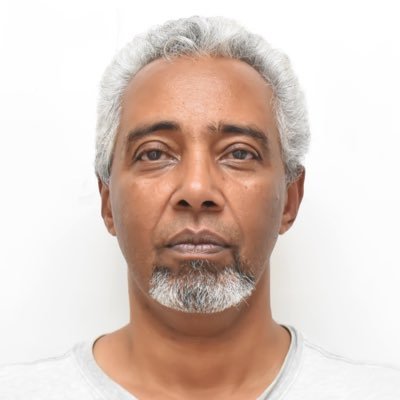
Albert Rudatsimburwa is a political analyst specialising in the Great Lakes region of Africa, with a focus on regional politics, governance and geopolitical developments.