By Political Correspondent
ZANU PF spokesperson Christopher Mutsvangwa has launched a scathing attack on Vice-President Constantino Chiwenga, accusing him of abusing the party’s annual conference platform to pursue what he described as a “self-centred and furtive pursuit of dictatorial aspiration for political power”.
Mutsvangwa accused Chiwenga of exploiting his role as the official who introduced President Emmerson Mnangagwa at the ruling party’s Annual National People’s Conference to air grievances against his boss and advance his political ambitions.
Mutsvangwa’s remarks came after Chiwenga delivered a politically charged address that questioned the ruling party’s leadership, decision-making processes and commitment to the principles that underpinned the 2017 military-assisted transition that removed the late former president Robert Mugabe.
In comments to The NewsHawks, Mutsvangwa dismissed Chiwenga’s intervention as a political miscalculation that failed to generate support.
“Ah… that one (Chiwenga) … he opportunistically abused the granted privilege to introduce H.E. (Mnangagwa) as guest of honour. His dissonant welter of ‘wrongs’ was brushed aside,” Mutsvangwa told The NewsHawks.
“He laboured in vain much like a loose bolt in a car engine. He remained thereafter hoping for follow-up support. None came. He was just shrugged off. No political harvest at all for unrequited political ambition.”
Mutsvangwa went on to contrast Chiwenga’s remarks with Mnangagwa’s economic agenda, saying the President’s Vision 2030 programme had overshadowed what he portrayed as his deputy’s ambitions.
“The EDM bus of economic deliverables through Vision 2030 and Prospect of Middle Income Nation Prosperity rolled over his self-centred and furtive pursuit of dictatorial aspiration for political power,” he said.
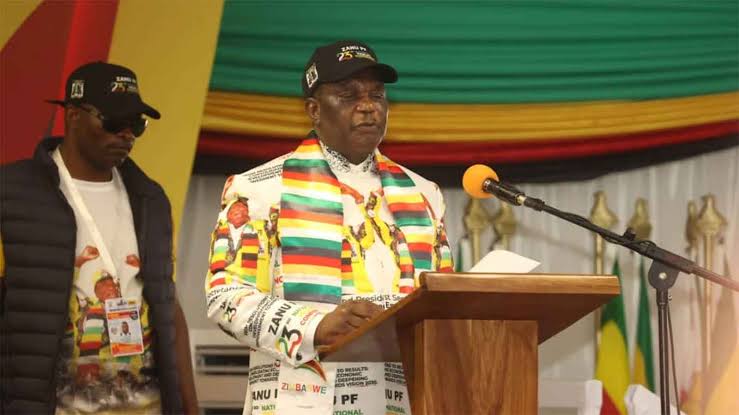
In his address while introducing Mnangagwa to the conference, Chiwenga challenged the ruling party to reflect on the circumstances that led to the 2017 military intervention and Mugabe’s eventual departure from office.
He questioned the motivations behind the creation of the so-called Second Republic and whether the party was repeating the mistakes that had precipitated the political upheaval.
“Are we not repeating the same mistakes?” Chiwenga asked.
He called for a “brutal and honest self-appraisal” of ZANU PF, urging party leaders to examine whether their decisions and resolutions reflected the wishes of ordinary members or were being imposed from the top.
Chiwenga stressed that the ruling party belonged to its members and the people of Zimbabwe, rather than individual leaders, whom he described as temporary custodians of the institution.
He also criticised what he called “mazvake mazvake” — a tendency towards individualistic, arbitrary and self-serving conduct — warning that such an approach would not take the party forward.
“Mazvake mazvake haana kwaanotisvitsa,” he said, meaning that self-serving individualism would lead the party nowhere.
The remarks were widely seen as a pointed challenge to the party’s leadership style and raised questions about the extent of internal disagreement over the direction of the ruling party.
Mutsvangwa’s counterattack adds to the growing political contest within ZANU PF, where the relationship between Mnangagwa and Chiwenga remains a major focus of attention amid debate over the party’s future leadership.
Chiwenga, a former military commander who played a central role in the 2017 intervention, is widely viewed as a key figure in the ruling party’s succession dynamics.
Mutsvangwa has previously defended Mnangagwa against criticism from his deputy and dismissed Chiwenga’s political manoeuvres, at one point accusing him of seeking to turn the ZANU PF presidium into a “kangaroo court”.
The latest exchange highlights the widening divide over leadership, internal accountability and the political direction of the party.
While Chiwenga framed his intervention around the need for introspection, grassroots participation and adherence to the party’s founding principles, Mutsvangwa portrayed it as an attempt to use a formal party occasion to advance personal ambitions.
The clash comes at a sensitive moment for ZANU PF, with the succession question increasingly intertwined with debates over governance, economic performance and the concentration of political power.