By Gabriel Manyati
Winky D has never been merely a musician.
From the earliest days of his career he has operated as a careful architect of persona, mythology and visual language, constructing an artistic identity that extends far beyond the recording studio or the dancehall stage. Costumes, aliases and carefully staged imagery have long functioned as extensions of his voice, allowing him to inhabit roles that amplify social critique, ghetto authority and theatrical presence.
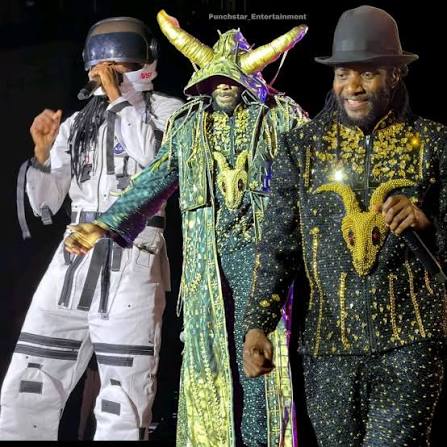
It is against this backdrop that his recent appearance at Tête-à-Tête Season 2 must be understood. On stage at Alex Sports Club in Harare, the artist known variously as the Ninja President, Gafa, DiBigman and Gombwe presented himself in an elaborate black-and-gold ensemble complete with a dramatic horned headpiece and a prominent goat-like motif across the chest.
The look immediately provoked discussion. Some viewers saw in the horns and the goat imagery a deliberate echo of Baphomet and the visual vocabulary of occult and Satanic traditions. Others insisted that the costume simply proclaimed Winky D as the GOAT, the Greatest of All Time, a claim of supremacy entirely consistent with his stature in Zimbabwean music.
What is not in dispute is the absence of any confirmed statement from Winky D or his team declaring that the costume represents Baphomet or signals allegiance to Satanism. No such admission exists. The argument that follows therefore does not rest on the claim that the artist is a Satanist. It rests instead on a more precise and more demanding contention: that an artist who has spent two decades teaching audiences to read his symbols cannot reasonably demand that those same audiences treat powerful, historically loaded imagery as culturally neutral the moment it becomes inconvenient.

A Career Built on Symbolism and Persona
Wallace Chirumiko emerged from Zimbabwe’s urban dancehall scene in the early 2000s and steadily rose to become one of the country’s most influential popular musicians. His career has been marked by successive reinventions of self. The Ninja President, Gafa, DiBigman and Gombwe are not casual nicknames. They are carefully cultivated personas that allow him to speak from positions of authority, menace, street wisdom and spiritual ambiguity.
Visual identity has always been integral to this project. Stage costumes, album artwork and performance aesthetics have functioned as part of the message rather than mere decoration. To suggest that the black-and-gold horned ensemble at Tête-à-Tête Season 2 should be dismissed as “just clothes” is therefore to ignore the consistent pattern of an artist who understands theatricality, provocation and the communicative power of the image. Winky D has repeatedly demonstrated that he knows how symbolism works. That history complicates any attempt to treat the latest costume as an accident of fashion.

The Earlier Controversies Over “Disappear”
The current debate did not arise in an ideological vacuum. Around 2015 and 2016, the release of the song “Disappear” triggered accusations from certain Christian quarters that the track and its associated imagery carried occult or Satanic implications. Circulars allegedly linked to church networks instructed congregants to avoid the music, claiming it functioned as an initiation song.
Winky D rejected the allegations firmly, affirming through his management that he was not a Satanist and pointing to his Rastafarian leanings and Catholic background. The episode matters because it reveals a pre-existing sensitivity within sections of Zimbabwean society to questions of spiritual association in popular culture. It does not, however, convert past accusations into present proof. Allegations are not evidence, and the earlier controversy should be remembered as context rather than as settled fact.
Understanding Baphomet and Its Associations
For many listeners the name Baphomet functions simply as a synonym for Satan. The historical reality is more layered. The name itself carries medieval associations, most notoriously through the accusations levelled against the Knights Templar. The familiar goat-headed, horned figure that dominates modern visual culture is largely a later development. In the nineteenth century the French occultist Éliphas Lévi produced the influential image of the horned, goat-headed Baphomet, often called the Sabbatic Goat.
Lévi’s symbolism was complex, concerned with the reconciliation or synthesis of opposites rather than with a straightforward illustration of the Christian Devil. Over subsequent decades the imagery became strongly associated with modern occultism and, later, with organised Satanism. The Sigil of Baphomet, which places a goat’s head within an inverted pentagram, emerged as an important emblem in that tradition.
None of this means that horns automatically equal Baphomet, or that a goat motif automatically equals Satanism, or that the wearing of a horned costume constitutes proof of personal allegiance to the Devil. Such equivalences are intellectually lazy. At the same time it is equally dishonest to pretend that horned goat imagery carries no established cultural and historical association with occult and Satanic visual traditions. The associations exist. They are documented. They form part of the shared symbolic vocabulary of the modern West and of the global cultures influenced by it.

A Scriptural Framework for Discernment
Scripture supplies a framework for Christian reflection on these matters that goes beyond mere proof-texting. Ephesians 5:11 instructs believers to “have no fellowship with the unfruitful works of darkness, but rather reprove them.” The verse draws a clear distinction between light and darkness and places upon the Christian a responsibility to examine spiritual associations rather than to ignore them. 1 Corinthians 10:21 sharpens the point: “Ye cannot drink the cup of the Lord, and the cup of devils.”
The warning concerns the impossibility of combining incompatible spiritual identities or practices. Association matters. 1 Thessalonians 5:22 urges believers to “abstain from all appearance of evil.” The language is careful. It does not demand that every ambiguous image be treated as demonic, but it does require discernment about the meanings that conduct and symbolism communicate in public. Romans 14:13 adds a further dimension by warning against placing a stumbling-block or an occasion to fall in a brother’s way. Influence carries responsibility.
An artist of Winky D’s cultural weight does not perform in a private vacuum; his choices shape the imaginative landscape of many who admire him. Finally, 1 Thessalonians 5:21 calls believers to “prove all things; hold fast that which is good.” The command is neither panic nor uncritical acceptance. It is an invitation to investigate, to understand historical context, to listen to explanations and then to exercise considered judgement.
These texts do not prove that Winky D is Satanic. They establish a Christian grammar for thinking about symbolism, association, influence and the boundary between light and darkness.

The “GOAT” Interpretation and Its Limits
The defence that the goat imagery simply proclaims Winky D as the GOAT deserves serious consideration. It is plausible. The artist’s stature within Zimbabwean music makes the claim of supremacy entirely coherent. Intention, however, does not automatically erase association. Symbols can communicate multiple meanings at once. An artist may intend “Greatest of All Time” while sections of his audience, shaped by different cultural and religious formation, see Baphomet because of the visual and historical freight that horned goat imagery carries. The decisive question is whether an artist as sophisticated and experienced as Winky D could reasonably be unaware of those associations. Given his long record of deploying visual provocation with precision, the claim of pure innocence strains credibility.
Winky D in Zimbabwean Cultural and Political Context
Winky D’s career has frequently involved social criticism, political provocation and resistance to authority. The controversy surrounding the album Eureka Eureka and the song Ibotso demonstrated once again his willingness to use art as a vehicle for confrontation and commentary, even at personal and professional cost. Zimbabwe remains a society in which Christianity retains significant cultural power and in which concepts such as Satan, demons, angels, spiritual warfare and occultism continue to resonate deeply. In such a context the deployment of conspicuous horned imagery cannot be treated as culturally neutral. The symbols arrive already charged.
Art can depict darkness without endorsing it. Representation is not the same as identification, and provocation is not the same as allegiance. Yet the distinction does not dissolve the responsibility that attaches to the deliberate use of loaded symbols. Artistic freedom remains important. It does not, however, render symbols meaningless. The more sophisticated the artist, the greater the responsibility to understand the cultural and spiritual meanings attached to the images he chooses to deploy.
Discernment Rather Than Panic
The real question is not whether Winky D secretly worships Baphomet. There is no evidence establishing that claim. The real question is why an artist who understands the power of symbolism would choose imagery carrying such strong occult and Satanic associations, and whether Christians should simply dismiss those associations because the artist may have intended the image to mean “GOAT.”
Artistic freedom does not abolish the communicative force of symbols. Christians are justified in interrogating the imagery, in tracing its history, in listening carefully to any explanation the artist may offer, and in testing what they see against the light of Scripture. Discernment, not panic, is the required response. Sometimes a costume is simply a costume. Sometimes, particularly in the hands of an artist who has spent decades teaching audiences to read his symbols, the costume is part of the message.