By Gabriel Manyati
In the days after the Mbuya Nehanda ferry went down, the shore near Kariba became a place of quiet, exhausted waiting.
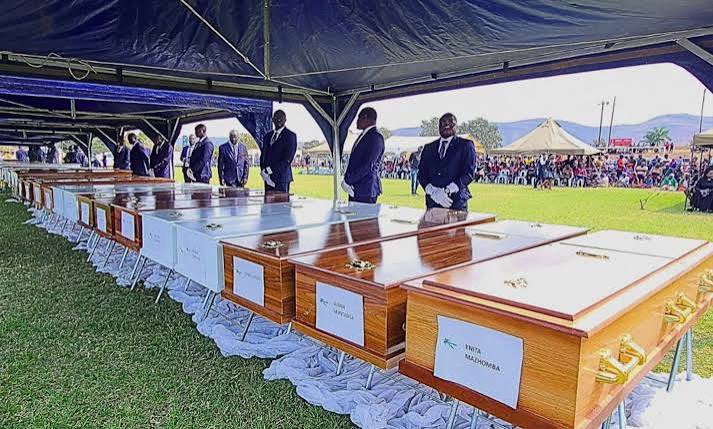
Families gathered at the district hospital and the command centre, scanning lists, examining clothing and personal items recovered from the water, hoping for a name that would bring closure or at least allow a burial.
Some had already waited nearly a week. Others still faced the possibility that DNA testing would be needed as bodies deteriorated. Children were among the dead. Breadwinners were gone. Households that had relied on the cheap, essential ferry link between Kariba town and the fishing communities around Chalala suddenly confronted funeral costs, lost income and the long silence that follows a mass-casualty event on a vast inland sea.
On 11 August 2026 the state-operated ferry, run by the Rural Infrastructure Development Agency, capsized on Lake Kariba while travelling from Kariba towards Chalala. It was the deadliest transport disaster in Zimbabwe’s recorded history. By late August the confirmed death toll stood at 97, with 96 victims identified by next of kin and one still unnamed. Seventy-seven people were rescued. The vessel’s authorised capacity was 90 passengers. Preliminary official statements later acknowledged it had been carrying far more people and cargo, with estimates ranging from more than 150 to around 180 including goods.
Survivors described rough conditions, water entering the vessel and pleas to turn back that were not heeded. The ferry was operating with only one functioning engine. Strong south-westerly winds generated the rough water known locally as the Binga Wave. President Emmerson Mnangagwa declared a national disaster and acknowledged serious deficiencies in the country’s maritime capabilities.

Two weeks after the sinking, police arrested Ignatius Chiome, the 49-year-old Kariba District Coordinator for RIDA. He was charged with culpable homicide and appeared in court, where he was remanded in custody. The Zimbabwe Republic Police confirmed the arrest and said further details would follow as investigations continued. Chiome has not yet entered a plea.
The state is examining administrative failures, overloading and breaches of operational safety procedures. Government ministers earlier pointed to the captain’s decision to sail despite Meteorological Services Department advice against it, while also defending the vessel’s fitness certificate. The captain did not survive. These are allegations and lines of inquiry, not settled findings.
The court process will determine individual responsibility. What the charge itself signals is that authorities accept the possibility of negligence or systemic failure rather than treating the disaster as pure misfortune.
The government announced emergency cash assistance of US$100 for each affected person, payable to survivors and to the next of kin of the deceased, together with food hampers. The payment was framed as help with immediate and funeral expenses, not as compensation for loss of life. In practical terms, US$100 in Zimbabwe today covers a modest portion of a basic funeral, transport, food and temporary accommodation for relatives who travel to identify and collect bodies. It does not replace a breadwinner’s income, settle outstanding debts or restore the long-term security of a household that has lost a parent.
Families have described the gesture as limited relief at a moment of overwhelming need. Additional private contributions, including from banks and individual gifts such as the US$4 000 awarded by the First Lady to a survivor who helped others, have provided further support in some cases. Whether the US$100 has reached every qualifying household efficiently remains part of the public conversation about the administration of the response.
The disaster did not occur in a vacuum. Lake Kariba is a vital, low-cost transport corridor for rural communities who face long and expensive road alternatives. The Mbuya Nehanda was an ageing vessel with a documented history of operational challenges on the lake. Survivors reported life jackets buried under luggage and difficult access in the chaos. Earlier assessments of the government ferry fleet had noted persistent breakdowns and the need for modernisation. Weather warnings existed. Overloading was later acknowledged by the state. Search and rescue involved police, parks authority personnel, local boat operators and the military, yet the scale of the loss and the difficulty of body recovery highlighted capacity constraints on a vast body of water. The tragedy surpassed the 1991 Nyanga bus disaster, which killed 89 people, mostly schoolchildren. Patterns of preventable transport deaths, whether on roads or water, raise the same institutional questions about inspection regimes, enforcement of capacity limits, maintenance standards and emergency preparedness.
Public reaction has mixed gratitude for the declaration of a national disaster and the arrest of an official with deeper unease. Many Zimbabweans see the swift relief announcement and the criminal charge as necessary steps. Others ask whether the system that allowed an overloaded, ageing ferry to sail in deteriorating conditions is being fully examined, or whether accountability stops at a single district coordinator. The modest size of the relief payment has sharpened a parallel conversation about value and inequality. In the same period, high-profile displays of wealth and large private gifts circulating in Zimbabwean public life have prompted ordinary citizens to ask, without accusing any individual of connection to the ferry, what the measured response to the loss of 97 lives reveals about priorities. The question is one of perception and political symbolism: how a society weighs the ordinary citizen’s life against the scale of conspicuous spending elsewhere.

The families left behind continue the work of identification, burial and survival. Some communities in the Nyaminyami area lost multiple relatives in a single afternoon. Children lost parents. Traders and fishers lost their means of livelihood along with their lives. The replacement of the ferry service and the rehabilitation of alternative routes matter for the living who still depend on the lake. So does the outcome of the culpable homicide case and any broader inquiry into regulatory and operational failures. The central question that remains is whether the response to Lake Kariba will end with relief payments and one criminal charge, or whether it will produce lasting changes in the institutional practices that allowed a preventable disaster to claim so many lives.