By Correspondent
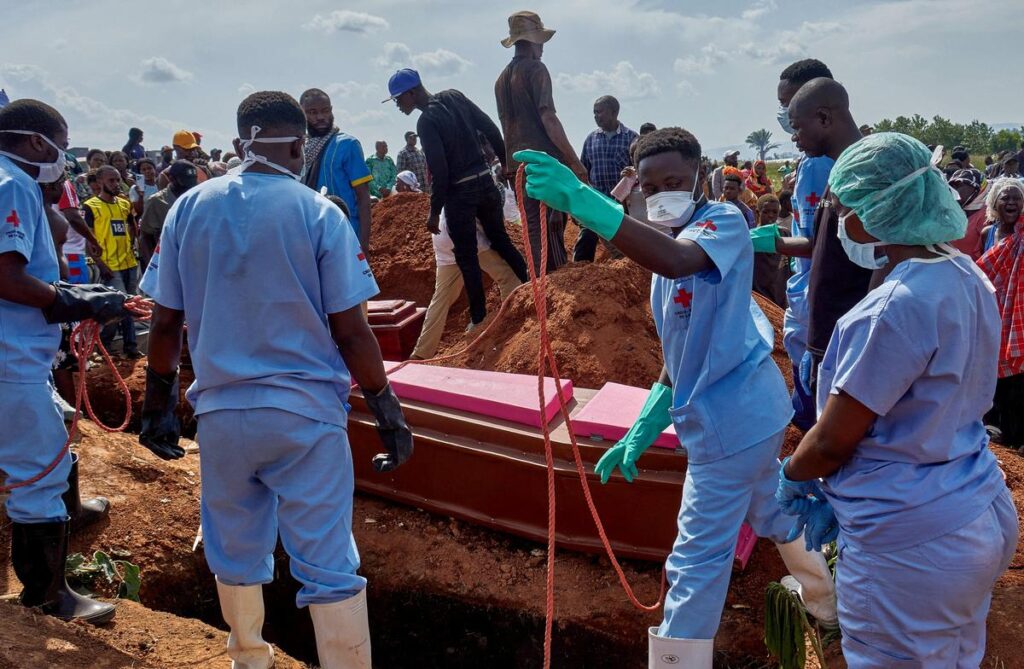
More than 300 children have died in the Democratic Republic of Congo’s worsening Ebola outbreak, with health authorities and humanitarian agencies warning that women and children are bearing a disproportionate share of the crisis.
The outbreak, caused by the rare Bundibugyo strain of Ebola, has been concentrated in Ituri province, which accounts for the overwhelming majority of reported infections.
Ituri Province, in northeastern DRC, has emerged as the epicentre of the latest Ebola outbreak.
According to the United Nations Children’s Fund (UNICEF), children account for nearly a quarter of confirmed Ebola cases but almost a third of all deaths.
The outbreak began in mid-May and has since spread across several provinces, overwhelming already fragile health services in communities affected by conflict and displacement.
“The outbreak has also severely disrupted essential healthcare, with fear of infection keeping people away from health facilities,” UN Deputy Spokesperson Farhan Haq told journalists in New York.
“In the hardest-hit areas, use of health services has dropped by more than 40 per cent in recent months, as fear of infection keeps people away,” Haq said.
The crisis is particularly severe in Ituri, where nearly one million people have been displaced by conflict. Women and children make up about 80 per cent of the displaced population, according to the UN Office for the Coordination of Humanitarian Affairs.
Maternal health crisis
The Ebola outbreak is also threatening maternal healthcare, with pregnant women increasingly avoiding hospitals because of fears of contracting the virus or being isolated.
The UN Population Fund (UNFPA) has warned that maternal deaths in Ituri have nearly doubled since the outbreak began.
About six women are now dying every week from childbirth-related complications, while Ebola infection during pregnancy is associated with an extremely high risk of fetal loss.
Humanitarian agencies say restoring public confidence in health facilities is therefore critical to containing both the Ebola outbreak and its wider consequences.
About 13,000 community workers have been deployed by the Congolese health ministry and international partners, including the World Health Organisation (WHO), UNICEF and the Africa Centres for Disease Control and Prevention (Africa CDC).
The workers have reached more than 2.4 million people with information on Ebola prevention and early detection and conducted more than 500,000 household visits aimed at combating misinformation and encouraging people to seek treatment early.
Hope from vaccine trial
Amid the worsening outbreak, hopes of containing the virus have been raised by new evidence suggesting that an existing Ebola vaccine could provide some protection against the Bundibugyo strain.
A WHO technical advisory group has recommended that Ervebo, the only licensed Ebola vaccine, be prioritised for a Phase 3 randomised clinical trial during the current outbreak.
“The members recommended Ervebo, the only licensed Ebola vaccine, be prioritised for inclusion in a randomised clinical trial in the context of the ongoing outbreak,” the advisory group said.
The recommendation followed preliminary animal studies indicating that Ervebo could provide some cross-protection against Bundibugyo virus, particularly against death.
In one study, three of four non-human primates vaccinated with Ervebo survived exposure to the virus, compared with one of four animals in a control group.
An unpublished ferret study also found that a research version of the vaccine provided full protection, with all animals in the control group dying within 10 days of exposure.
However, WHO experts have cautioned against assuming that Ervebo will prevent infection or transmission.
The advisory group said the vaccine might not provide strong protection against symptomatic disease or transmission, although it could potentially reduce the risk of death.
A vaccine specifically designed against Bundibugyo remains the preferred option, but candidates targeting the strain are still undergoing early-stage development.
Two potential Bundibugyo vaccines are currently in human clinical trials, while another candidate is also being developed.
Outbreak surpasses 4,000 cases
The latest government figures indicate that the outbreak has now surpassed 4,000 confirmed cases and 1,800 deaths.
The virus has spread across 53 health zones in five provinces — Ituri, North Kivu, South Kivu, Haut-Uele and Tshopo.
Ituri remains the epicentre, accounting for about 87 per cent of reported cases, while North Kivu accounts for roughly 11 per cent.
The scale and speed of the outbreak have heightened pressure on health authorities to expand vaccination, testing, treatment and community surveillance.
For families in the worst-affected communities, however, the immediate challenge remains access to trusted healthcare as fear of Ebola continues to keep patients away from hospitals.
The WHO says the vaccine trial could provide critical evidence on whether an existing tool can help reduce deaths while researchers continue efforts to develop a vaccine specifically targeting the Bundibugyo strain.