By Bhekithemba Ncube/Tichaona Katsvamutima/Kudzai Jakachira
Zimbabwe’s economic growth is projected to slow from 8.3 percent in 2025 to 5 percent in 2026 before moderating further to 3.5 percent in 2027, amid a challenging global economic environment and shifting regional growth prospects.
The projections point to a gradual moderation in economic activity over the next two years, following the strong expansion recorded in 2025.
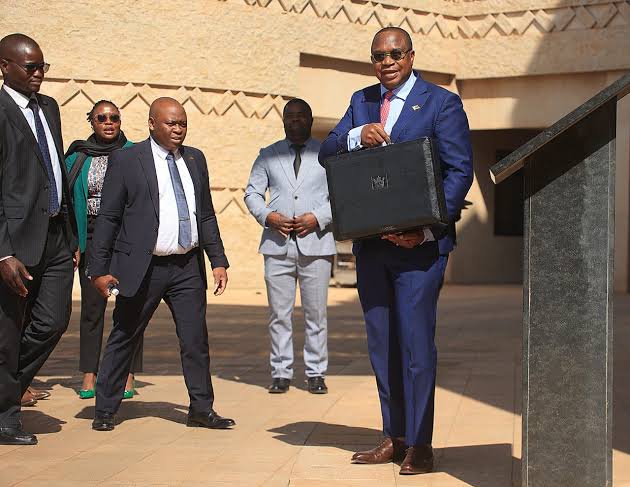
Finance Minister Professor Mthuli Ncube announced the macroeconomic figures today while presenting the 2027 National Budget in Parliament.
Zimbabwe’s growth is expected to remain above the projected Southern African Development Community (SADC) average of 3.2 percent in 2026 and 3.1 percent in 2027.
However, the country’s growth trajectory is expected to converge closer to regional levels, with SADC growth projected at 3.1 percent in 2027 compared with Zimbabwe’s 3.5 percent.
The global economy is also expected to experience moderate growth, with worldwide output projected to expand by 3.1 percent in 2026 before improving to 3.4 percent in 2027.
Emerging markets and developing economies are expected to grow by 3.7 percent in 2026 and 4.4 percent in 2027, while advanced economies are projected to record growth of 2.1 percent and 1.8 percent over the same period.
Within Sub-Saharan Africa, economic growth is forecast at 4.3 percent in 2026, improving slightly to 4.4 percent in 2027.
Zimbabwe’s projected growth remains relatively strong compared with several regional economies. Botswana, which recorded an estimated contraction of 0.7 percent in 2025, is expected to recover to 4.4 percent in 2026 before slowing to 2.2 percent in 2027.
Mozambique’s growth is projected to improve from 3.1 percent in 2025 to 3.8 percent in 2026 and 4.5 percent in 2027, while Zambia is expected to expand by 4.3 percent and 4.7 percent over the same period.
Foreign currency inflows strengthen
Meanwhile, Zimbabwe recorded a significant increase in foreign currency receipts during the first nine months of 2026, with total inflows rising by 33.67 percent to US$15.89 billion from US$11.89 billion during the corresponding period in 2025.
Export proceeds remained the largest source of foreign currency, contributing US$11.02 billion, representing 69.36 percent of total receipts.
The figure represents a 56.61 percent increase from US$7.04 billion recorded during the same period last year.
Diaspora remittances also increased by 39.86 percent to US$2.45 billion, while foreign investment more than doubled, rising by 122.77 percent to US$409.9 million.
However, receipts from non-governmental organisations declined by 44.66 percent to US$453.8 million, while private loan proceeds fell by 28.9 percent to US$1.39 billion.
The growth in foreign currency receipts coincided with improvements in the country’s external sector, with the current account recording a surplus of US$1.38 billion in the third quarter of 2026.
Inflation remains relatively contained
On the domestic front, ZiG inflation figures show that annual headline inflation stood at 4.3 percent in October 2026, compared with 3.7 percent in September.
Monthly ZiG inflation, however, slowed to 0.2 percent in October from 0.5 percent in September.
The figures suggest relative stability in monthly price movements, although annual inflation remains subject to fluctuations.
US dollar-denominated inflation also showed signs of moderation, with annual inflation declining from 3.5 percent in September to 3.2 percent in October 2026.
Monthly US dollar inflation stood at 0.1 percent in October, down from 0.3 percent in September.
Public finances and debt pressures
Zimbabwe’s fiscal projections indicate an increase in government revenue and expenditure over the medium term.
Revenue is projected to rise from ZiG287.64 billion in 2026 to ZiG349.54 billion in 2027, while expenditure is expected to increase from ZiG290.87 billion to ZiG358.30 billion.
The figures point to a projected budget deficit of ZiG8.76 billion in 2027, equivalent to 0.5 percent of gross domestic product (GDP).
Capital expenditure is expected to increase significantly from ZiG41.08 billion in 2026 to ZiG73.58 billion in 2027, reflecting planned investment in infrastructure and development projects.
Meanwhile, Zimbabwe’s total public and publicly guaranteed debt stood at approximately US$22.17 billion at the end of September 2026.
Of this amount, bilateral debt accounted for US$7 billion, while multilateral creditors were owed approximately US$4.88 billion.
Government securities accounted for US$5.18 billion, with compensation for former farm owners contributing another US$2.82 billion.
Education and health receive largest allocations
Under the proposed 2027 budget allocations, the Ministry of Primary and Secondary Education received the largest allocation among government ministries, with ZiG47.70 billion.
The Ministry of Health and Child Care was allocated ZiG35.46 billion, followed by the Ministry of Finance with ZiG30.40 billion and the Ministry of Agriculture, Mechanisation and Water Resources Development with ZiG27.56 billion.
The Ministry of Defence was allocated ZiG23.44 billion, while the Ministry of Home Affairs and Cultural Heritage received ZiG21.77 billion.
The overall appropriation, including retention funds and other statutory allocations, amounts to ZiG365.57 billion, rising to a grand total of ZiG387.90 billion after loan repayments.
The allocations underline the government’s spending priorities in education, healthcare, agriculture, public administration and national security.
Mining and manufacturing maintain growth momentum
The manufacturing sector continued to record improvements, with the Volume of Manufacturing Index rising from 112.48 in 2022 to 159.1 in 2026.
The mining sector is projected to grow by 5.3 percent in 2026, before slowing to 5.1 percent in 2027 and 4.7 percent in 2028.
Growth is expected to recover to 6.5 percent in 2029 before moderating to 5.2 percent in 2030.
International commodity prices are expected to provide mixed prospects for the economy.
Gold prices are projected to average US$4 600 per ounce in 2026, up from US$3 442 in 2025, before declining to US$4 250 in 2027.
Platinum prices are forecast to rise to US$1 950 per ounce in 2026 before easing to US$1 750 in 2027.
Brent crude oil prices are projected to increase from US$69 per barrel in 2025 to US$91 in 2026 before declining to US$79 in 2027.
The commodity outlook could have implications for Zimbabwe’s export earnings, mining investment and production costs.
Infrastructure development continues
The economic programme also highlights ongoing and planned infrastructure developments, including the Manyame River and Mucheke bridges, the Harare-Kanyemba Road project and the Mabvuku interchange.
The Batoka Gorge energy project also features among the country’s strategic energy initiatives.
In rural electrification, a total of 513 institutions and facilities had been connected to electricity between January and November 2026, according to the provincial breakdown provided.
These included 215 primary schools, 102 secondary schools, 82 rural health centres and clinics, 43 chiefs’ facilities and 17 villages.
The figures highlight continued investment in rural infrastructure and access to essential services.
Overall, the projections paint a picture of an economy expected to maintain positive growth, supported by export performance, mining, manufacturing and infrastructure investment.
However, the anticipated slowdown in GDP growth, rising public expenditure and substantial public debt remain important considerations for Zimbabwe’s medium-term economic outlook.