Midlands Correspondent
The need for inclusive healthcare has come into focus at Gweru Provincial Hospital, where 25 student nurses and nine members of the hospital’s management have undergone sign language training to improve communication with deaf patients.
The training, conducted by Sunrise Sign Language Academy (SSLA), is part of efforts to ensure that people with hearing impairments receive quality healthcare services without communication barriers.
The latest programme, the sixth conducted at the institution, brings the number of health professionals trained by the academy to about 150, covering competency, intermediate and advanced levels.
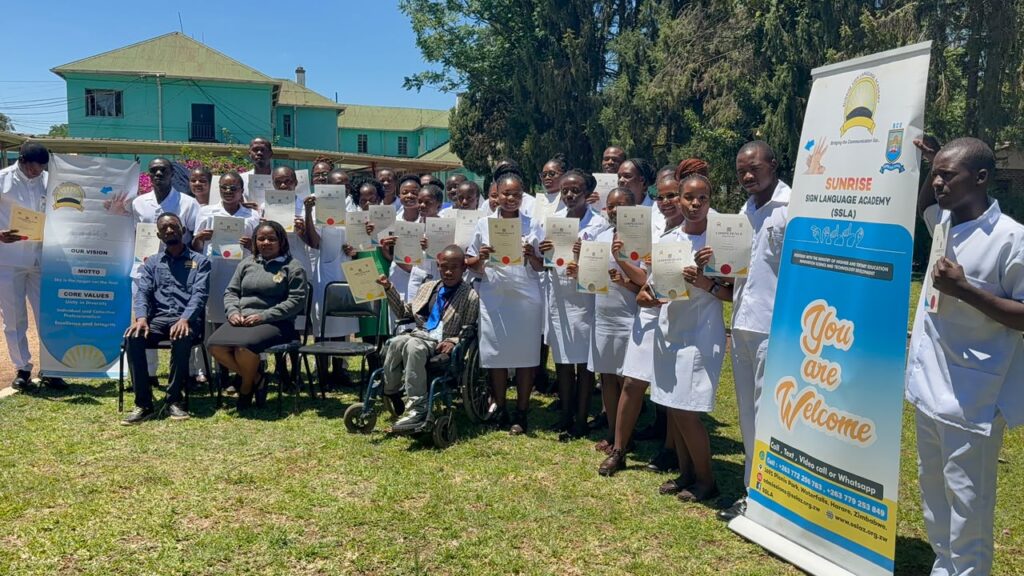
Speaking at the official certification ceremony, Gweru Provincial Hospital Environmental Health Technician Principal Tutor Nelia Mafumba, who represented the hospital’s management, said sign language training went beyond learning gestures, equipping healthcare workers with the communication skills and attitudes needed to promote dignity, respect and inclusion.
“One of the most important lessons from this training is that communication is a fundamental part of healthcare,” she said.
Mafumba said the ability to communicate effectively with deaf patients was essential to ensuring that they received appropriate care and understood the information provided by healthcare professionals.
“Coming to a hospital while sick and being unable to communicate where you are experiencing pain, or being unable to understand what healthcare professionals are telling you, can be a reality for a deaf person,” she said.
“That is why learning sign language is important. It can make a patient feel welcome, respected and understood.”
She said healthcare professionals had a responsibility to make medical facilities accessible to everyone, adding that negative attitudes towards people with disabilities could be as much of a barrier as physical inaccessibility.
“As healthcare workers, we have a responsibility to make our facilities welcoming and accessible to everyone,” she said.
Mafumba urged student nurses and young professionals to put the knowledge they had acquired into practice as they entered the healthcare system, saying inclusive communication should become an integral part of service delivery.
She challenged the graduates to help build a healthcare system in which every patient, regardless of their disability, could access services with dignity and confidence.
Mafumba also reminded the graduates that certification marked the beginning, rather than the end, of their learning journey, urging them to use their skills to make a meaningful difference in patients’ lives.
“Let us work towards a healthcare system where every patient, including those who are deaf, can say: ‘I am seen, I am respected and understood’,” she said.
She applauded the Ministry of Health and Child Care for supporting the introduction of sign language training at the institution.
SSLA director Douglas Mapeta, a United Nations-accredited sign language volunteer, said healthcare professionals needed sign language skills to improve communication, protect patient confidentiality and reduce reliance on interpreters.
Mapeta said direct communication between healthcare workers and deaf patients was particularly important in medical settings, where accurate information is essential for diagnosis and treatment.
“It is very important to provide sign language training in the health sector because members of the deaf community also need professional services and confidentiality, which some interpreters may struggle to guarantee.
“One-on-one communication can produce better results than third-party interpretation,” he said.
Mapeta added that interpreters without specialised knowledge of medical terminology could compromise communication between patients and healthcare professionals, potentially affecting the quality of diagnosis and treatment.
Nothando Chembwa, who received an advanced-level certificate, said the training had equipped her with the skills to communicate directly with members of the deaf community and minimise the risk of misinformation.
Beyond the health sector, SSLA has also conducted sign language training in prisons, schools, churches and the wider community as part of its broader efforts to promote inclusivity and ensure that people with hearing impairments can participate meaningfully in society.