By Gabriel Manyati
The ZANU PF Politburo meeting scheduled for 2pm on Friday 9 October 2026 never took place. Members had already begun assembling at the party headquarters in Harare when the session was abruptly cancelled. The reason was not administrative.
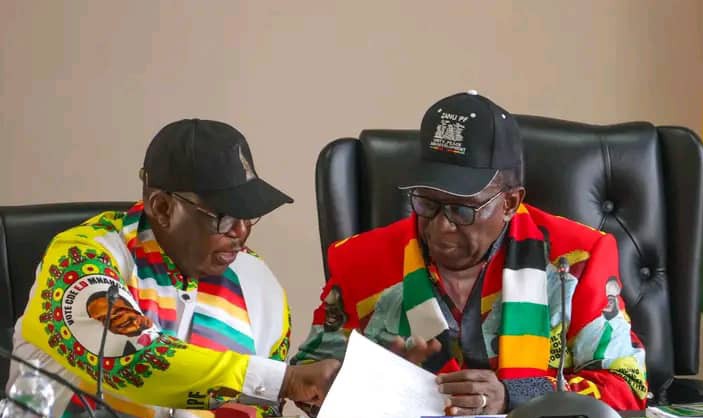
It was the direct collision between President Emmerson Mnangagwa and Vice President Constantino Chiwenga over proposals to rewrite the party’s constitution so that it matches the far-reaching changes introduced by the Constitution of Zimbabwe Amendment (No. 3) Act, 2026.
An investigation by The NewsHawks established that the postponement followed fierce disagreement over the alignment exercise.
Official statements sought to downplay the episode. ZANU PF spokesperson Chris Mutsvangwa said: “There was a clash or an overflow of programmes, and the meeting was postponed.”
Director for Information and Publicity Farai Marapira described it as a “clash of programmes; but nothing serious.”
Those explanations sit uneasily against the political context.
The meeting had been called to prepare constitutional changes for the party’s 23rd National People’s Conference, due to open at Chinhoyi University of Technology from 12 to 17 October.
The subject was the rules that will govern leadership succession.
The timing, only days before that conference, and the identity of the two principals made the cancellation a public signal that the succession contest had moved from private corridors into the party’s highest decision-making body.
Constitutional Amendment Act No. 3, signed into law by Mnangagwa on 7 July 2026, fundamentally altered Zimbabwe’s political architecture. It extended the terms of the president, parliament and local authorities from five to seven years and applied the new tenure to the sitting president, pushing Mnangagwa’s current term from 2028 to 2030.
It replaced the direct popular election of the president with election by a joint sitting of the Senate and National Assembly.
It expanded the Senate and transferred voter registration functions.
The national changes created an immediate requirement for ZANU PF to revise its own constitution. Party legal affairs secretary and Justice Minister Ziyambi Ziyambi confirmed in late September that the Legal Standing Committee had been instructed to align the party document with the national amendments so that the changes could be considered at Chinhoyi.
The alignment is not a technical housekeeping exercise.
The ZANU PF constitution governs how the party nominates its presidential candidate, how congresses and conferences are timed, and how internal power is distributed among the Politburo, Central Committee and provincial structures.
Changing those rules while the national timetable has already been extended would lock in Mnangagwa’s longer tenure inside the party itself and alter the pathway any successor must follow.
Mnangagwa’s allies frame the reforms as necessary for continuity, the completion of infrastructure projects and the realisation of Vision 2030. Chiwenga’s camp views them as a calculated effort to postpone the succession transition, consolidate the president’s authority and restrict the vice president’s route to the highest office.
The present confrontation is the latest chapter in a succession struggle that began with the military-assisted transfer of power in November 2017. Then-commander of the Zimbabwe Defence Forces Constantino Chiwenga played a decisive role in the events that ended Robert Mugabe’s 37-year rule and elevated Mnangagwa to the presidency.
The alliance that removed Mugabe contained competing interests from the outset.
Chiwenga’s military and war-veteran networks expected a structured transition. Mnangagwa’s political and business networks sought to consolidate control.
No settled succession arrangement acceptable to both sides ever emerged.