By Gabriel Manyati
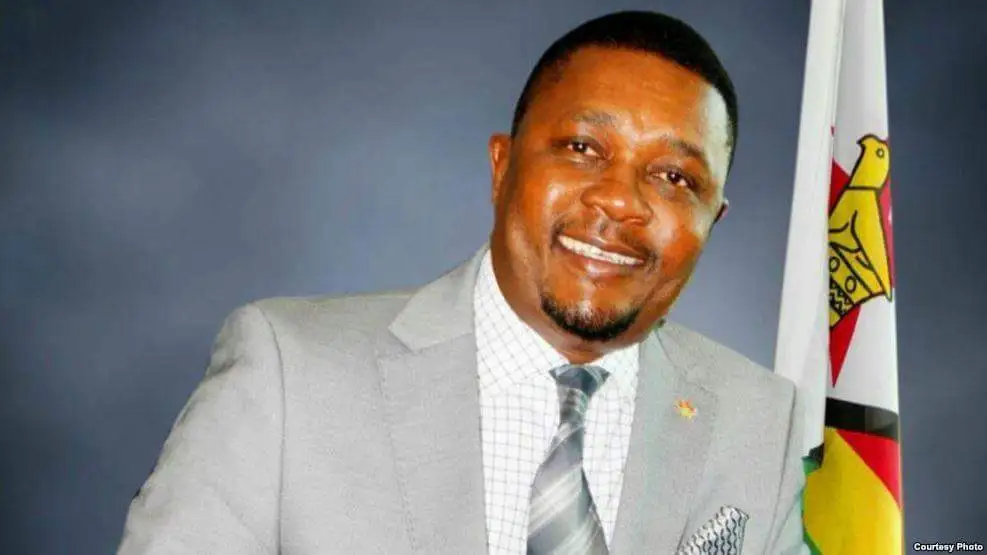
There is a particular kind of quiet that descends when the state turns off its heat. For years, Walter Mzembi inhabited the gilded corridors of global diplomacy, gliding through UNWTO summits, addressing foreign correspondents in tailored suits, and issuing imperious directives as Robert Mugabe’s Minister of Foreign Affairs and Tourism.
Fast-forward to September 2026. A flurry of media reports paints a picture so bleak it borders on biblical tragedy: the former globe-trotting diplomat, having seen his real estate portfolio allegedly stripped and sold off during years of self-exile, is now bunking in a spare room at his nephew’s house in Harare.
When journalists pressed him about the coverage, Mzembi tried to deflect with dry bravado, asking if anyone seriously believed he had lost everything down to his “brick and mortar and my brains.” Yet local observers could not help but spot him at recent public funerals clad in the exact same purple suit – a visual testament to a political career reduced to a single, carefully maintained outfit.
Mzembi maintains that the tales of his absolute financial ruin are wildly exaggerated, if not entirely malicious. Yet the institutional reality of his panic is beyond dispute: ZANU PF Masvingo confirmed that Mzembi has officially begged for re-admission into the party. His penalty before his application is even considered? Being summoned before a provincial committee like a chastised schoolboy to account for tweets and Facebook posts critical of the regime.
It is the ultimate humiliation for a former G40 kingpin. But inside the ruling party, nobody is surprised. They have seen this horror film before.
Decades ago, the late party patriarch Edson Zvobgo coined the chilling aphorism that has since become the central survival doctrine of Zimbabwean politics: “It’s cold outside ZANU PF.” Zvobgo did not mean it as a gentle metaphor for losing an election. He meant it as an existential warning. Beyond the roaring fireplace of the ruling establishment lies an uninhabitable wasteland where influence, wealth, and basic state protection evaporate overnight.
As political scientists Nic Cheeseman and Brian Klaas have noted in their extensive work on African political systems and authoritarian longevity, dominant ruling parties rarely operate as mere electoral vehicles. In competitive authoritarian regimes, the party transforms into a totalising gatekeeper. It controls access to public sector jobs, commercial farming land, mining concessions, commercial import licences, state procurement tenders, and institutional protection.
To hold a party card, therefore, is to possess a key to the economic ecosystem; to forfeit it is to find the entire economic matrix locked from the inside.
Viewed through the lens of Cheeseman and Klaas’s analysis of patronage regimes, Zvobgo’s warning ceases to be mere colourful political theatre or tribal bravado. It is a precise description of a political economy where access to state resources and survival inside the ruling apparatus have become completely indistinguishable.
In such systems, political office is not simply an avenue for public service or policy debate; it is the fundamental mechanism through which personal wealth, business immunity, and social standing are underwritten.
When an insider leaves or is cast out, they are not just losing a seat in parliament or a Cabinet portfolio. They are being ejected from the network of state-sanctioned patronage that made those assets viable in the first place. The “cold” is not an ideological vacuum – it is the financial and structural frost that sets in when state machinery, banking regulators, tax authorities, and law enforcement cease acting as your protective shield and begin operating as weaponised instruments of state power.
To leave ZANU PF – whether by choice, purge, or coup – is to be stripped of this very ecosystem. When the party revokes your card, the state revokes your life. The diplomatic passport is cancelled; the armed security detail vanishes from your gate; the lucrative state tenders dry up; and the Zimbabwe Revenue Authority suddenly develops a keen interest in your back taxes. The phone stops ringing because speaking to you is a career hazard for anyone still inside.
The historical graveyard is littered with political heavyweights who thought their personal stature could withstand the frost.
Consider Edgar Tekere. In the late 1980s, “Two Boy” was the fearless Secretary-General of ZANU, a man whose liberation credentials rivalled Mugabe’s own. When he broke away to form the Zimbabwe Unity Movement (ZUM) in 1989, he drew massive, roaring crowds.
But when election day came in 1990, the state machinery crushed him. ZUM won just two parliamentary seats, and Tekere spent his twilight years in Mutare, financially drained and politically isolated, watching his former comrades control the nation’s wealth while he relied on their occasional charity.
Then there was Joice Mujuru. For a decade, she served as Mugabe’s vice president, backed by a sprawling network of security chiefs and business alliances. When the purges hit her in 2014, she was cast out into the wilderness. Stripped of the state apparatus, her subsequent political vehicles – Zimbabwe People First and the National People’s Party – resembled paper boats launched into a hurricane.
Without state intelligence to guide her, state media to glorify her, and state funds to oil her machinery, her immense political capital collapsed into irrelevance almost overnight.
Saviour Kasukuwere, the once-feared “Tyson” who ruled ZANU PF’s commissariat with an iron fist, found himself stranded in South African exile after 2017. When he attempted to challenge Mnangagwa in the 2023 presidential race, he was not even defeated at the ballot box; the legal system simply engineered his disqualification before his name could touch a voting slip.
Jonathan Moyo, the intellectual architect of ZANU PF’s most ruthless propaganda campaigns, was reduced to firing off academic critiques from foreign living rooms, discovering too late that his brilliant mind meant very little without the state broadcaster backing his word.
Yet the frost is not entirely inescapable. The historical record reveals a crucial, subtle exception: challenging ZANU PF is only fatal if you attempt to build a completely new home.
When war veteran Margaret Dongo was cheated out of the Harare South nomination in 1995, she ran as an independent, took the party to court, proved electoral fraud, and won the subsequent re-run. Dongo survived because she fought as a street-level insurgent rather than a deposed aristocrat expecting her former status to save her.
Even more instructive is the art of the prodigal return. Didymus Mutasa, once Mugabe’s terrifying Minister of State Security, was purged alongside Mujuru in 2015. After years spent shivering in the political cold, his vehicles impounded over unpaid debts, Mutasa swallowed his pride, ceased his attacks, and quietly negotiated his way back. By 2026, he was comfortably installed in ZANU PF’s “Council of Elders” – a soft landing pad designed specifically for former rebels who have agreed to repent and behave.
The ultimate irony, of course, belongs to President Emmerson Mnangagwa himself. In November 2017, he was stripped of his vice-presidency, expelled from the party, and forced to flee across the border into Mozambique under cover of darkness. Less than three weeks later, he returned not as a penitent petitioner, but at the tip of a military bayonet to take the presidency.
For the average Cabinet minister watching this political theatre, the lesson is clear. Unless you have the army behind you, rebellion is a fool’s errand. The fate of former insiders acts as a brutal form of risk insurance for the current establishment. It explains why ministers who privately loathe each other will smile together at rallies, and why men who were publicly humiliated during factional wars will crawl back on their knees to beg for re-admission.
It is easy to mock Walter Mzembi for writing letters pledging to “contribute positively to party programmes” while agreeing to start over as an ordinary cell-level member. But mocking him misses the deeper, more terrifying truth about Zimbabwe. Mzembi’s bid to return is not proof of ZANU PF’s ideological brilliance; it is proof that Zimbabwe has failed to build a society where a citizen can survive financially, legally, and socially without the patronage of the ruling party.
“It’s cold outside ZANU PF” is thus not a political slogan. It is a description of an authoritarian state that has successfully fused itself to the national economy, ensuring that those who sit near the fire eat, while those who step outside freeze.