By Tichaona Katsvamutima
Somewhere in rural Zvimba, many years ago, a farm worker fashioned a crude guitar for a young boy who had no idea that music would one day become part of his identity.
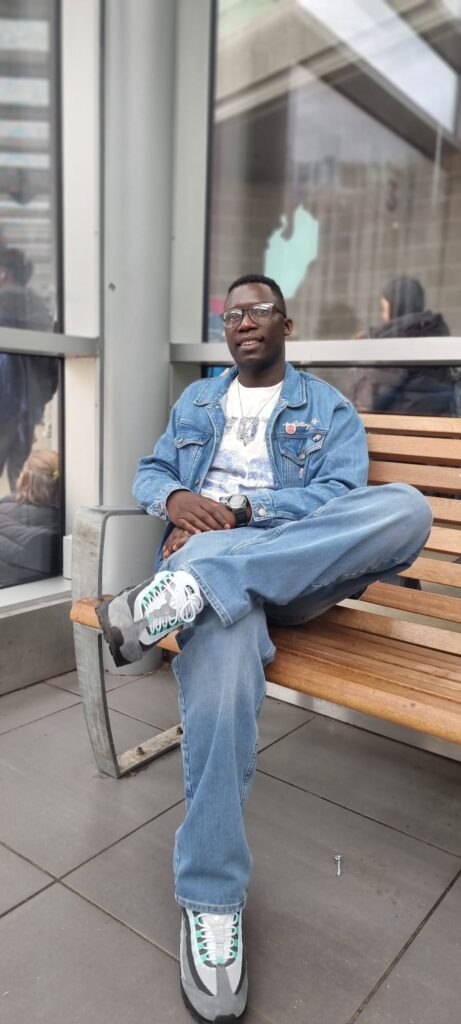
Today, many Zimbabweans scrolling through Facebook or TikTok may know 36-year-old John Gwenzi from his videos and social commentary. But behind the content creator whose clips have attracted attention online is another ambition rapidly taking shape — music.
As a boy, Gwenzi could barely play the homemade instrument. There were no professional lessons, no studio and no serious ambition to become an artist.
He simply sat with the man he remembers as London — or perhaps Randani — strumming the guitar and inventing songs for amusement.
Nobody paid much attention.
Neither did Gwenzi.
Yet decades later, thousands of kilometres away in Scotland, that childhood memory has acquired an almost prophetic significance.
The village boy who went on to study law is now creating Conscious Reggae and Afro-Pop music with the help of artificial intelligence — part of a technological shift challenging traditional ideas about who can make music and how it can be created.

“I even created some songs, which I still find amusing when I remember them today,” Gwenzi recalls.
“Nobody, including myself, took it seriously.”
Perhaps they should have.
From Zvimba to Scotland
Gwenzi grew up under Chief Chirau in Zvimba and attended St Barnabas Primary School, about seven kilometres from his homestead — a journey that later inspired the title of his album 14 Kilometers – St Barnabas.
He later attended Nemakonde High School and Chinhoyi High School, where he says he was the best Arts student in 2008.
His interest in music grew in Chinhoyi, where he attended live shows and followed the rise of Urban Grooves and later Zim Dancehall.
But he initially chose a different path, graduating with a Bachelor of Commerce in Law from the University of South Africa in 2015.
Life eventually took him to Scotland.
Gwenzi says adjusting to the climate and being far from familiar surroundings was difficult, but the move also gave him time to reflect.
“There were times when I would walk along the beach, sit on a bench and ask myself: ‘What is really my purpose in this life?’” he says.
Music increasingly became part of the answer.
AI gives his words a voice
Gwenzi did not regard himself as a conventional musician or a great singer, but he believed he could write.
Already using social media to discuss music, culture, equality and social issues, he began experimenting with artificial intelligence to turn his ideas and lyrics into songs.
“AI gave me an opportunity to transform ideas, lyrics and messages into music,” he says.
“It did not create my passion; it gave my passion another way to speak.”
The growing use of AI in music has sparked debate over creativity, authenticity and the future role of musicians.
Gwenzi sees the technology differently — as a tool assisting rather than replacing his creative input.
“I do not simply throw lyrics into an AI system and accept whatever comes back,” he says.
“I bring the ideas, the words, the message and the creative direction, while AI assists with aspects of the production.”
From experiment to 19 songs
Gwenzi says he has now produced a catalogue of 19 songs.
*His projects include the EP Gwenzi Rakaviga Mambo Psalms, two albums — 14 Kilometers – St Barnabas and Three Hearts — and the single Dzoka Kumba.

His latest seven-track album, Three Hearts, explores love, family, emotional struggles and mental health.*
Gwenzi says the project was inspired by a case involving a mother and her two daughters who were allegedly killed by the man they knew as husband and father.
The tragedy left him questioning how love within a family could turn into violence.
One of the album’s songs, Rudo Runokunda Ruvengo — Love Conquers Hate — reflects the message he says he wants his music to carry.
“If one person listens to my music and chooses love instead of hatred, understanding instead of judgement, or dialogue instead of violence, then the music has already achieved something meaningful,” Gwenzi says.
Can rural artists join the AI revolution?

Gwenzi’s experience also raises a wider question for Zimbabwe’s emerging creatives.
AI may lower some of the traditional barriers to producing music, but access to reliable internet, smartphones, computers, electricity and digital skills remains uneven.
Gwenzi believes this could leave rural talent at a disadvantage.
“AI could widen the gap if access to technology, affordable internet, digital education and creative resources remains unequal,” he says.
“A child in a rural village should not have less opportunity to create, learn and express themselves simply because of where they were born.”
For Gwenzi, the issue brings his journey full circle.
His own musical story began without a computer, recording equipment or studio — just a handmade guitar at a rural homestead.
Despite now using AI in Scotland, he says his music remains rooted in Zimbabwean ideas of hunhu, family and community.
“Technology may be modern, but the values I bring through it are deeply rooted in where I come from,” he says.
One dream remains
There is still something AI cannot give Gwenzi.
Despite releasing 19 songs and building an audience through social media, his definition of musical success is not millions of streams, viral videos or celebrity status.
He wants to perform his music live before an audience.
“For me, success is not only about numbers, streams or fame,” he says.
“It is about taking an idea that once existed only in my mind and turning it into something that can touch another human being.”
And somewhere behind that ambition remains the image of a little boy in Zvimba holding a guitar somebody had made for him by hand, creating songs nobody thought would matter.
“In many ways, my younger self has risen again,” Gwenzi says.
“The child who once played with a handmade guitar in a rural homestead could not have imagined that one day those early, almost forgotten musical instincts would find a new expression through technology.”
The instrument has changed. The village has given way to Scotland. The law graduate has found another calling.
Artificial intelligence now sits where a homemade guitar once did — between John Gwenzi and the music he wants the world to hear.
The technology may provide the sound, but the story still comes from Zvimba.