By Tichaona Katsvamutima
Zimbabwe’s football integrity controversy has taken a new turn after Harare-based legal practitioner and sports integrity advocate, Lonias Rozvi Majoni, escalated concerns over alleged match manipulation, disputed player registrations and club ownership arrangements to Parliament, following what he says is a failure by the Zimbabwe Football Association (ZIFA) and Premier Soccer League (PSL) to acknowledge his formal complaints.
Majoni is now seeking parliamentary scrutiny of the country’s legal and regulatory framework while giving football authorities until December 2 to address the allegations through their internal processes.
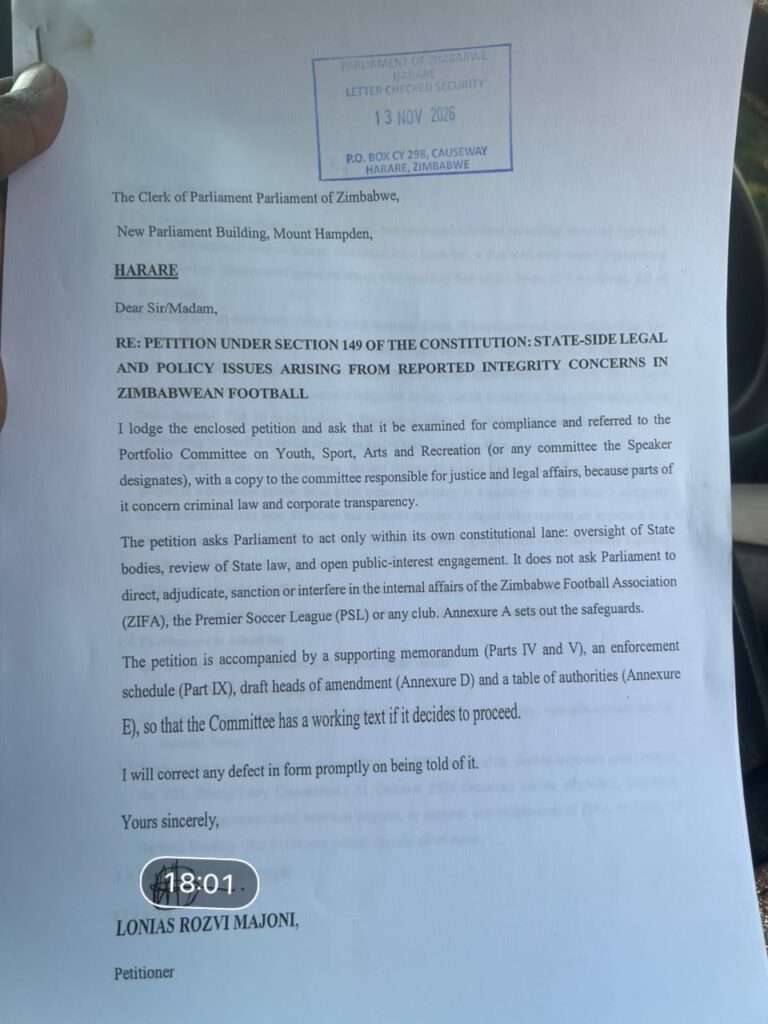
A copy of the petition seen by National Interest News bears an official Parliament of Zimbabwe stamp confirming its receipt on November 13, 2026, marking a significant escalation in a dispute that could eventually reach international football governing bodies if domestic mechanisms fail to produce a response.
“Although the 30-day action window has not yet closed, the 7-day period for ZIFA and PSL to acknowledge and respond to our petition has lapsed without reply,” Majoni said.
“Consequently, we have engaged Parliament on the aspects of this matter within its jurisdiction, without interfering in ZIFA’s internal processes or breaching FIFA statutes.
“We have taken these steps in good faith and the public interest to exhaust all local remedies before escalating the matter internationally, which could carry adverse consequences.”

The latest development follows Majoni’s petition to ZIFA and the PSL, demanding independent scrutiny of allegations involving Scottland FC, CAPS United and other domestic football stakeholders.
Majoni requested written acknowledgment within seven days and an update on action taken within 30 days. He maintains that the November 9 acknowledgment deadline passed without a response.
His parliamentary petition, lodged under Section 149 of the Constitution, seeks scrutiny of possible gaps in Zimbabwe’s laws governing sports corruption, corporate ownership transparency, whistleblower protection and institutional accountability.
Majoni wants the matter referred to the Parliamentary Portfolio Committee on Youth, Sport, Arts and Recreation, with input from the committee responsible for justice and legal affairs where appropriate.
At the heart of Majoni’s argument is the distinction between football’s authority to enforce its own regulations and the State’s responsibility to investigate conduct that may constitute a criminal offence.
“Some parts of this story, however, do not belong to football at all. A bribery approach to a player is a potential crime. Who truly owns a company is a question for the State’s company and financial-crime law,” the petition states.
“This petition asks Parliament to do one thing: ensure that what belongs to the State is handled by the State, and leave what belongs to football to football.”
The controversy partly stems from a widely circulated audio recording allegedly involving an attempt to influence CAPS United goalkeeper Washington Arubi ahead of a league encounter against Scottland FC.
According to reports cited in the petition, a woman identified in media reports as B. Mudhosi allegedly asked Arubi to approach teammates, claiming she had been sent by an individual referred to as “Scott”.
Arubi reportedly rejected the approach, while Scottland FC publicly denied authorising any attempt to influence the goalkeeper or the match outcome.
The recording’s authenticity, the identities of those involved and whether anyone associated with the club authorised the alleged approach remain unverified.
A separate dispute concerns allegations that Scottland FC exceeded the permitted number of player registrations during the mid-season transfer window.
The PSL instituted disciplinary proceedings, but its disciplinary committee dismissed the Chibuku Super Cup charge on October 31, because the complaint had not complied with the prescribed time limit.
The ruling did not resolve the substantive registration allegations, prompting questions about the applicable regulations and the handling of complaints.
Majoni’s petition acknowledges conflicting accounts of the permitted registration limit and calls for clarification of the relevant rules.
It also raises questions about possible common ownership or control involving Scottland FC and Hunters FC, alongside broader concerns over sponsorship arrangements in domestic football.
However, the document explicitly recognises that shared sponsorship does not necessarily establish common control and that no wrongdoing has been proven.
Beyond the immediate allegations, Majoni is pressing for an examination of whether Zimbabwe has adequate legislation to combat manipulation of sporting competitions.
His proposals include consideration of a specific criminal offence covering match manipulation, stronger legal protection for players and officials who report suspected corruption, and clearer disclosure requirements for individuals who ultimately own or control football clubs.
He also wants Parliament to establish whether the Zimbabwe Republic Police and Zimbabwe Anti-Corruption Commission have received complaints concerning the reported approach to Arubi and, if so, what action has been taken.
The petition further proposes reforms to the Sports and Recreation Commission Act to strengthen reporting, transparency and cooperation between football authorities and State institutions without compromising ZIFA’s independence.
Majoni is seeking to avoid a similar confrontation by restricting parliamentary involvement to matters falling within the State’s constitutional and legislative authority.
“Parliamentary oversight is not sporting interference. ZIFA keeps exclusive autonomy over the rules of the game,” the petition states.
It expressly rejects parliamentary involvement in disciplinary rulings, player eligibility, club licensing or the appointment and removal of football officials.
Under the proposed arrangement, Parliament would initially engage State institutions on legal and regulatory questions while allowing ZIFA and the PSL to complete their internal processes.
If no response is received by December 2, Majoni wants Parliament to consider inviting football authorities and interested clubs to a voluntary, non-adversarial briefing from December 3.
The same deadline could also trigger a separate escalation through international football’s established integrity mechanisms.
“If no football body is seized of the matters and no reasons are given by 2 December 2026, the Petitioner reserves the right to report through football’s own channels: the FIFA Ethics Committee (investigatory chamber) or FIFA’s confidential reporting platform, and CAF in respect of CAF competitions,” the petition states.
However, Majoni has ruled out supporting measures that could punish Zimbabwean football collectively.
“He does not seek, and would not support, any suspension of ZIFA, any freeze of development funding, or the exclusion of any club from continental competition, because those would harm players and clubs,” the document adds.
The parliamentary escalation now places the spotlight on the responsiveness of Zimbabwe’s football governing bodies and the effectiveness of existing mechanisms for handling integrity complaints.