By Tichaona Katsvamutima
The Zimbabwe Union of Journalists (ZUJ) has demanded an urgent review of journalists’ salaries, warning that inadequate remuneration is undermining media workers’ livelihoods and threatening the quality, independence and long-term sustainability of journalism in Zimbabwe.
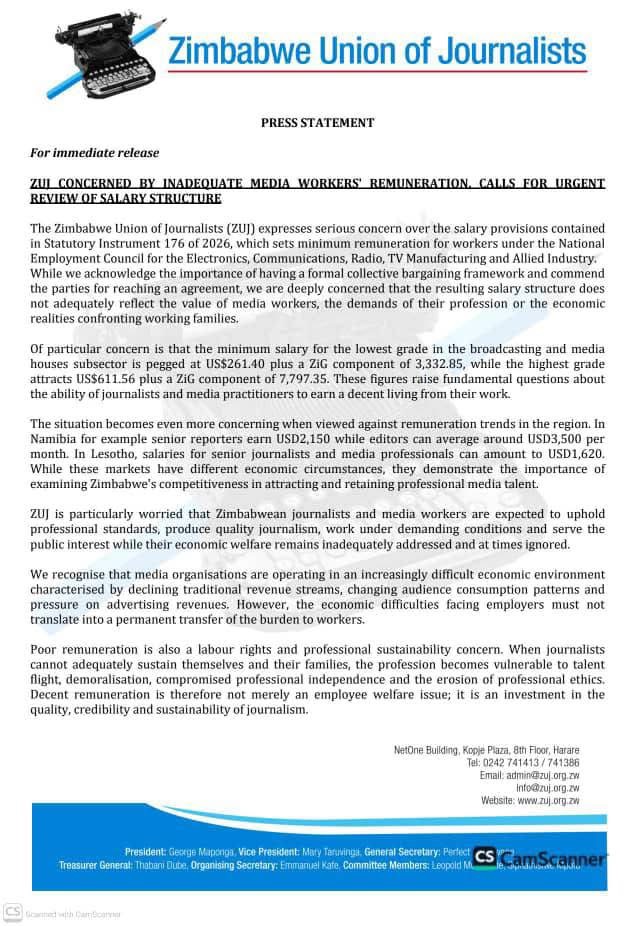
In a strongly worded statement, the union called for an overhaul of the salary structure prescribed under Statutory Instrument 176 of 2026, arguing that the agreed wages fail to reflect journalists’ professional responsibilities, experience and the rising cost of living.
ZUJ wants salaries brought closer to a living wage, regular adjustments to cushion workers against rising prices and meaningful negotiations between employers and workers’ representatives to improve conditions across the media industry.
Under the disputed salary structure, the lowest grade in the broadcasting and media houses subsector earns a minimum of US$261.40 plus ZiG3,332.85, while the highest grade receives US$611.56 supplemented by ZiG7,797.35.
Although the union welcomed the collective bargaining agreement and commended the parties involved, it questioned whether the resulting remuneration adequately reflects the economic realities confronting journalists and their families.
“We are deeply concerned that the resulting salary structure does not adequately reflect the value of media workers, the demands of their profession or the economic realities confronting working families,” ZUJ said.
The union also highlighted substantial salary disparities between Zimbabwean journalists and their counterparts elsewhere in Southern Africa, warning that comparatively low wages could drive experienced professionals out of the country’s media industry.
According to figures cited by ZUJ, senior reporters in Namibia earn approximately US$2,150 monthly, while editors receive an average of US$3,500. In Lesotho, senior journalists and media professionals can earn up to US$1,620 per month.
While acknowledging differences in economic conditions, taxation and living costs, the union argued that Zimbabwe must assess its competitiveness in attracting and retaining experienced journalists.
“These markets have different economic circumstances, yet they demonstrate the importance of examining Zimbabwe’s competitiveness in attracting and retaining professional media talent,” the union said.
Beyond the financial disparities, ZUJ warned that inadequate remuneration could have serious consequences for professional independence and ethical reporting, particularly as journalists face increasing economic pressures.
“Poor remuneration is also a labour rights and professional sustainability concern,” the union said.
“When journalists cannot adequately sustain themselves and their families, the profession becomes vulnerable to talent flight, demoralisation, compromised professional independence and the erosion of professional ethics.”
The warning highlights the difficult position of journalists expected to investigate corruption, scrutinise powerful institutions and hold public officials accountable while struggling to meet their own financial obligations.
Although low salaries do not automatically lead to unethical conduct, financial vulnerability can expose media practitioners to conflicts of interest and external pressures capable of undermining independent reporting.
ZUJ maintained that improving journalists’ welfare should be regarded as an investment in the credibility and sustainability of journalism rather than merely an additional employment expense.
The union acknowledged the financial difficulties confronting media organisations, including declining traditional revenue streams, changing audience consumption patterns and pressure on advertising income.
“We recognise that media organisations are operating in an increasingly difficult economic environment,” ZUJ said, cautioning that these challenges “must not translate into a permanent transfer of the burden to workers.”
It argued that publishers and broadcasters must balance financial sustainability with their responsibility to provide fair remuneration, insisting that investment in journalists is as important as spending on technology, infrastructure and content production.
As part of its proposed reforms, ZUJ called for sustained engagement between employers and workers’ representatives, regular salary reviews reflecting changes in the cost of basic goods and services, and greater recognition of journalists’ qualifications, experience and professional responsibilities.
The union also demanded strict compliance with registered collective bargaining agreements without undermining more favourable employment arrangements already in place.
It further urged the relevant National Employment Council parties to revisit the salary schedules and clarify subsequent adjustments, noting that the broadcasting and media salary schedule under Statutory Instrument 176 covers January to March 2026 despite the instrument being published in October.
The apparent discrepancy raises questions about the applicable remuneration period and whether the prescribed wages reflect economic developments since March.
ZUJ insisted that the long-term survival of Zimbabwe’s media industry cannot depend on the continued financial vulnerability of journalists, warning against a situation in which media workers are expected to defend the public interest while their own welfare remains neglected.
“Our position is clear, that Journalism must not become a profession in which workers are expected to defend the public interest while their own economic interests are neglected,” the union declared.
“A viable media industry requires viable media workers,” ZUJ added, emphasising the importance of investing in the people responsible for producing credible and independent journalism.
The union’s intervention comes as Zimbabwe’s media sector grapples with technological disruption, shifting advertising markets and changing news consumption patterns, raising concerns about the industry’s ability to retain skilled professionals under prevailing employment conditions.
ZUJ pledged to continue engaging employers and other stakeholders to secure improved remuneration, better working conditions and stronger protection of workers’ rights.
“Decent work, decent wages and dignity for every media worker remain non-negotiable,” the union concluded.