By Tichaona Katsvamutima
Deputy Chief Secretary to the President and Cabinet George Charamba has renewed his call for public funding of journalism in Zimbabwe, arguing that the media is a “public good” that should not depend entirely on commercial revenues or foreign-funded organisations for its survival.
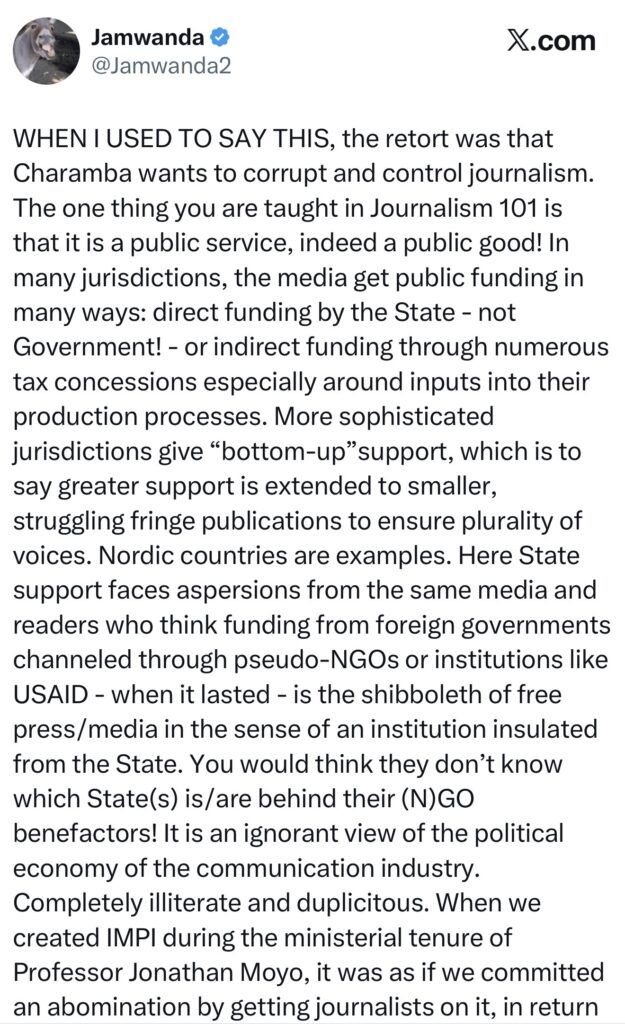
Writing on his X account, @Jamwanda2, Charamba said proposals for State support of the media had historically been viewed with suspicion in Zimbabwe, with critics interpreting such assistance as an attempt by government officials to influence or control journalists.
“When I used to say this, the retort was that Charamba wants to corrupt and control journalism,” he wrote.
Charamba argued that journalism was fundamentally a public service and said that principle provided justification for public support of media institutions.
“The one thing you are taught in Journalism 101 is that it is a public service, indeed a public good!” he said.
He pointed to international models under which media organisations receive direct or indirect public assistance, including tax concessions and support related to production costs.
Charamba singled out Nordic countries, where he said funding mechanisms provided greater assistance to smaller and struggling publications as a means of preserving media plurality.
“More sophisticated jurisdictions give ‘bottom-up’ support, which is to say greater support is extended to smaller, struggling fringe publications to ensure plurality of voices,” he said.
He also criticised what he described as a contradiction in attitudes towards media funding in Zimbabwe, arguing that some journalists who objected to State assistance had previously accepted support originating from foreign governments through non-governmental organisations and institutions such as USAID.
According to Charamba, regarding foreign-backed funding as compatible with media independence while automatically treating domestic State support as a threat reflected a misunderstanding of the political economy of journalism.
“You would think they don’t know which State(s) is/are behind their (N)GO benefactors!” he wrote, describing the position as “ignorant” and “duplicitous.”
Charamba also revisited the establishment of the Information and Media Panel of Inquiry (IMPI) during Professor Jonathan Moyo’s tenure as Information minister.
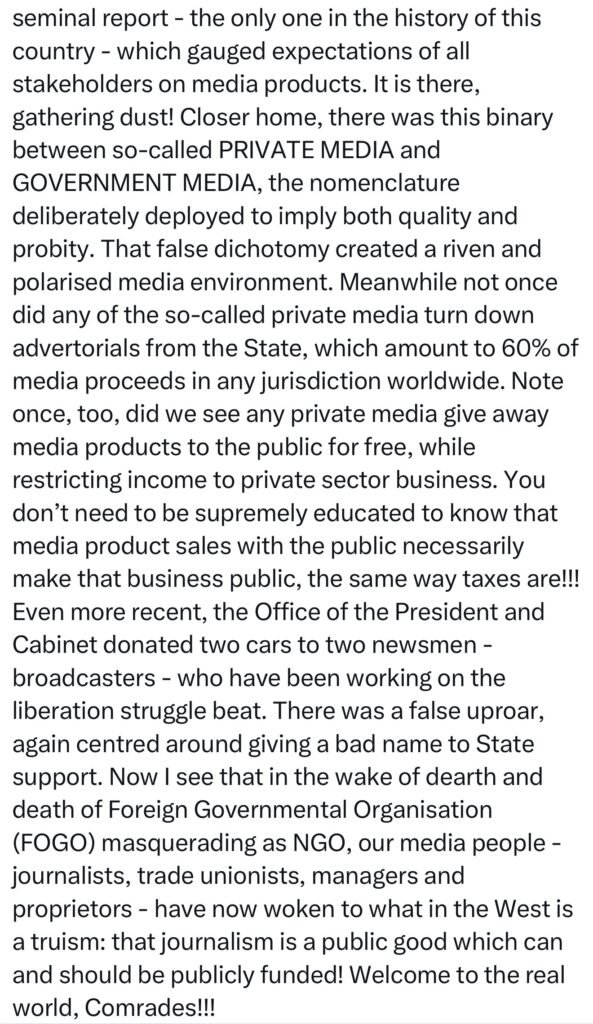
He said the decision to involve journalists in the inquiry and pay them modest stipends had attracted criticism at the time, despite the process eventually producing what he described as a seminal report examining the expectations of different stakeholders in Zimbabwe’s media industry.
“It is there, gathering dust!” Charamba said of the report.
He also challenged the traditional distinction between Zimbabwe’s “private media” and “government media”, arguing that the terminology contributed to the polarisation of the country’s media landscape.
“That false dichotomy created a riven and polarised media environment,” he said.
Charamba further argued that privately owned media organisations had themselves benefited financially from State advertising and advertorials while also generating revenue from members of the public purchasing their products.
He cited the recent donation by the Office of the President and Cabinet of two vehicles to two broadcasters covering Zimbabwe’s liberation struggle as another example of State assistance that had attracted criticism.
Charamba said changing economic circumstances, particularly the decline of foreign-funded organisations supporting journalism, were now forcing sections of Zimbabwe’s media industry to reconsider the question of public funding.
He argued that journalists, trade unionists, media managers and proprietors were increasingly recognising a principle he said had long been accepted in parts of the West — that journalism could legitimately receive public support without necessarily surrendering its independence.
“Now I see that in the wake of dearth and death of Foreign Governmental Organisation (FOGO) masquerading as NGO, our media people — journalists, trade unionists, managers and proprietors — have now woken to what in the West is a truism: that journalism is a public good which can and should be publicly funded!” Charamba wrote.
He concluded: “Welcome to the real world, Comrades!!!”