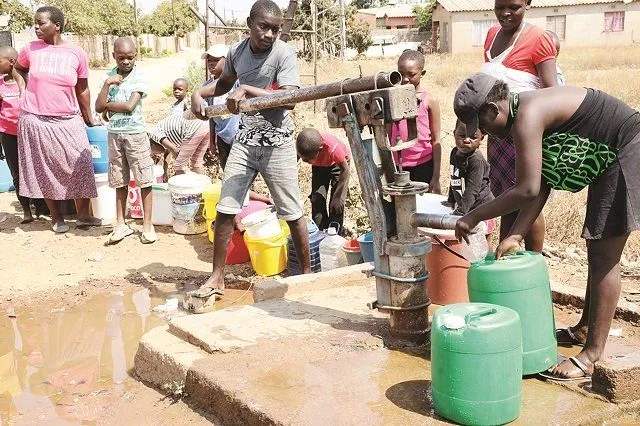
Across urban Zimbabwe, a quiet crisis has fundamentally reshaped daily life.
Tendai Ruben Mbofana
Cities and towns that once boasted reliable, running tap water for decades have seen their infrastructure crumble into near-total obsolescence.
In places like Redcliff, Harare, and surrounding urban centers, residents now endure dry taps not just for days or weeks, but for years on end.
The municipal water systems that once served as the lifeblood of urban living have effectively ground to a halt.
As a consequence of this structural collapse, citizens have done what any desperate population would do: turned underground.
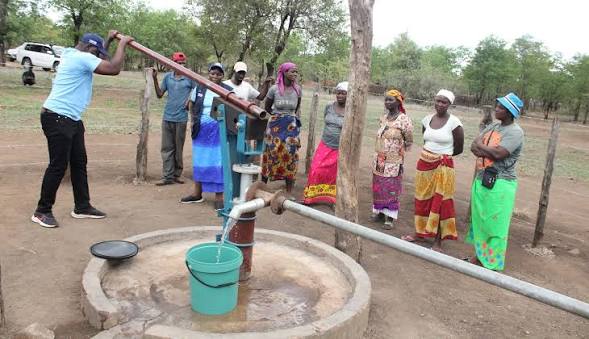
More and more households, institutions, and businesses are resorting to drilling private boreholes to secure the most basic human necessity.
In my own neighborhood in Redcliff, a week hardly goes by without the deafening roar of drilling rigs echoing through the streets.
It has become a ubiquitous sound, the soundtrack of a community forced to fend for itself.
What is most concerning, however, is that this desperate coping mechanism is no longer just a private, stop-gap measure.
The central government itself has embraced this trend as official policy, championing initiatives such as the Presidential Borehole Scheme.
Across the nation, every newly sank shaft is celebrated in the media as a milestone of progress, a triumphant solution to a crippling water crisis.
Yet, beneath this celebratory rhetoric lies a disturbing reality.
There is a disturbing sense of complacency among those in authority, who fail to treat our water crisis as the national emergency it truly is.
We are witnessing virtually no long-term policy vision aimed at genuinely reviving municipal water systems.
There is a glaring absence of major dam construction, modern water treatment expansion, or serious capital investment to replace aging, leaking distribution networks.
Instead, the drilling of boreholes is being treated as if it were a permanent, modern replacement for centralized water governance.
The silent assumption seems to be that once a pump is in the ground, our water worries are behind us.
But is this path truly sustainable?
Is it wise—or even safe—to depend on finite underground aquifers as a permanent substitute for civic infrastructure?
The short-sightedness of this approach becomes obvious when we consider the severe consequences of over-relying on groundwater.
Unregulated, mass extraction rapidly depletes local water tables.
When thousands of boreholes draw from the same shallow aquifers without artificial recharge, the water table drops precipitously.
This forces shallower wells to run dry and necessitating ever-deeper, more expensive drilling.
Furthermore, in densely populated urban settlements, unmonitored borehole water carries high risks of contamination from nearby soakaways, pit latrines, and industrial runoff, posing severe public health hazards.
In extreme cases, rapid sub-surface water extraction destabilizes the ground itself, leading to land subsidence and structural damage to homes and roads.
These risks are multiplied exponentially as climate change brings increasingly frequent and severe dry seasons.
Zimbabwe continues to suffer the lingering effects of recurrent droughts and intense El Niño events, such as we are presently facing.
These bring prolonged dry spells which drastically reduce natural groundwater recharge rates.
Underground aquifers are not bottomless reservoirs; they rely on consistent rainfall to replenish.
Relying on underground water during an unprecedented drought is like spending down a bank account without making a single deposit.
Eventually, the pump runs empty.
True water security cannot be extracted from a patch of suburban soil; it requires comprehensive, modern surface-water engineering.
Sustainable water management relies on integrated urban water schemes—constructing new supply dams, upgrading centralized treatment plants, harvesting rainwater at scale, and recycling wastewater for industrial and agricultural use.
Both central government and local authorities must urgently pivot away from borehole dependence as a primary strategy.
Authorities must prioritize massive capital investment into restoring and expanding piped water networks.
Local councils need to enforce strict regulations and hydrological mapping to prevent the haphazard proliferation of private wells.
At the same time, central government must build the necessary macro-infrastructure, such as bulk supply dams and modern purification facilities, to meet growing urban populations.
Countries that have successfully navigated acute urban water stress offer clear lessons.
Cities like Singapore and Windhoek have proven that long-term resilience lies in closed-loop water systems, aggressive leak reduction, desalinization, and advanced wastewater reclamation.
Not in digging thousands of unregulated holes in the backyard.
Boreholes can only ever be an emergency temporary buffer, never a country’s national water strategy.
Drilling deeper into the earth while ignoring our collapsing surface infrastructure is not progress; it is an illusion of self-sufficiency that masks a catastrophic governance failure.
If Zimbabwe does not wake up to the dangers of groundwater over-extraction, we risk waking up tomorrow to dry pipes and exhausted aquifers alike.
This is a double crisis from which no drilling rig will be able to save us.
- Tendai Ruben Mbofana is a social justice advocate and writer. Please feel free to contact him on +263715667700 or mb*******************@***il.com