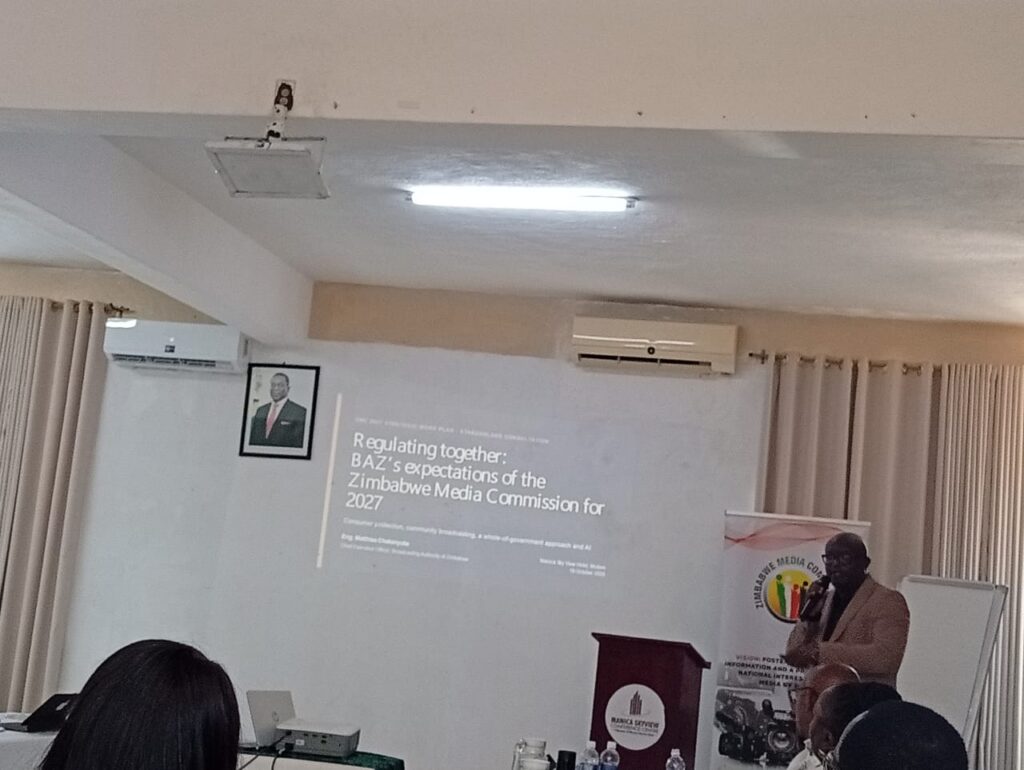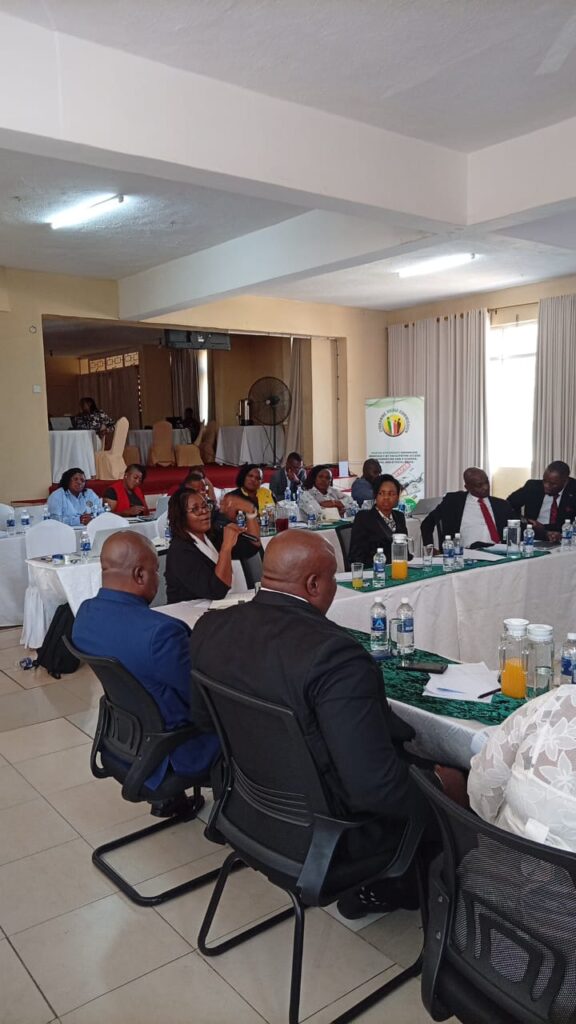
Media Alliance of Zimbabwe’s submission at the Zimbabwe Media Commission Strategic Plan Consultative Workshop held in Mutare on the 19th of October 2026
By Nigel Nyamutumbu
A fortnight ago, in response to social media discourse on the state of the media, the Deputy Chief Secretary in the Office of the President and Cabinet, Mr. George Charamba, made what I consider to be a measured call for public financing of media services as a public good.
Citing examples including, but not limited to, Nordic countries whose public investment into the media sector has sustained their media despite global challenges — the economic recession, shifting audience consumption and digital disruption.
I begin my submission to this strategic planning consultative workshop of the Zimbabwe Media Commission (ZMC), an independent constitutional body whose work impacts the media and information sector that I serve, with sustainability reflections rooted in the existential crisis facing the media.
The gesture by the Commission to extend invitations and call for input into its strategic planning process should be commended.
If anything, sustained engagement with media professional associations and media support organisations, as broadly represented by the Media Alliance of Zimbabwe (MAZ), to help shape ZMC’s priorities, is co-regulation in action. We appreciate it.
My reflection on the measured call by the Presidential spokesperson is a demonstration of how our advocacy has transformed from mere lamentation to proposing solutions.
Rather than lament, it is to lay a clear, honest picture of where we are, and to propose where we should go together.
In this submission, I will speak to five areas that I believe should influence the strategic thinking of the Commission in the short to medium term.
*A) THE STATE OF THE MEDIA IN ZIMBABWE – THE FIVE STORMS*
We are not in a normal downturn. We are in a media economic recession, and it cuts across.
*1. The Economic Recession:* Mainstream, online, community media and the civic society that supports them are all contracting. Advertising has migrated to platforms and is dollarized while our revenue is largely in ZiG. Foreign donor support to media development has shrunk by over 40% in the last two years. The result: newsrooms are cutting pages, cutting bureaus, cutting staff. Community radios are on air but cannot afford licensing and transmission costs.
*2. Declining Professional Standards:* This is a direct consequence of point one. When you have two reporters covering an entire province, when you have no budget for fact-checking, you get what we saw at Kariba. The quality of the media product is suffering, and with it, public trust.
*3. The Political Challenge:* We continue to face a political culture that views the media as either a praise-singer or an enemy. This attitude manifests in the securitization of journalism – accreditation for national events remains unpredictable, and access to public officials remains difficult. This pushes journalists towards sensationalism because hard, accountability journalism is made too costly.
*4. Poor Conditions of Service:* We cannot talk about professionalism without talking about the journalist. The average reporter in Zimbabwe earns below a living wage, has no medical aid, no contract security, and no safety net. This makes them vulnerable to brown-envelope journalism and to leaving the profession entirely. We are losing our best to PR and to the diaspora.
*5. The Rising Cost of Access to Information – News is Becoming Elitist:* I want to flag the recent decision by ZTN to put its prime content behind an OTT paywall as a case study. While we respect commercial decisions, when combined with data costs and paywalls, we are creating a two-tier information society. The poor consume rumour on WhatsApp for free, the rich access verified news for a fee. This is dangerous for democracy and for information integrity, and it is an area ZMC must reflect on under its mandate to promote access to information.
*B) REGULATORY CONCERNS AND CHALLENGES*
This is where the role of ZMC becomes critical.
*1. Regulation of Online Content Creators:* The funeral of a prominent public personality, Mr. Wicknell Chivayo, two weeks ago exposed our regulatory vacuum. It is reported that accredited journalists were disrupted, pushed, and had their cameras blocked by other online content creators and so-called citizen journalists who claimed equal rights to the press bay. The Commission received complaints. This is not about excluding creators; it is about protecting a professional space. If anyone with a smartphone is a journalist for the purposes of access, then no one is. We need a framework that distinguishes between a professional journalist bound by ethics and an online content creator bound by general law.
*2. The Unethical Coverage of Kariba:* The Kariba incident – where several outlets published unverified claims of a new dam wall crack – caused panic and economic harm. It was a failure of ethics, but also a failure of gatekeeping. It shows that peer review is weak and that speed is now beating accuracy.
*3. Labour Disputes – ZTN, AMH and NRTV:* We have active labour disputes at ZTN, Alpha Media Holdings, and NRTV involving unfair dismissals and non-payment of salaries. ZMC’s mandate includes promoting fair labour practices in the media under Section 243 of the Constitution. When media employers violate labour rights, it is a media freedom issue, because it undermines the independence of the journalist.
*4. Striking the Balance – Free Expression vs. Information Integrity:* ZMC is walking a tightrope. On one side, over-regulation will be seen as censorship. On the other, under-regulation allows disinformation, deepfakes, and hate speech to thrive. The Commission’s strategic plan must explicitly find this balance.
*5. Multiple Regulatory Bodies:* A broadcaster today answers to BAZ, ZMC, POTRAZ, and the Cyber Security Centre. A journalist answers to ZMC and VMCZ. This multiplicity causes forum-shopping and regulatory confusion. We need a harmonization framework.
*C) OPPORTUNITIES FOR GROWTH*
Despite the storms, there are five real opportunities.
First, *increased internet penetration* – now over 70% – gives us a bigger audience than ever before, if we can monetize it.
Second, *the Freedom of Information Act.* The law is there. What is missing is implementation. If ZMC aggressively pushes for the designation of Information Officers and proactive disclosure, it can unlock a new era of investigative journalism.
Third, *strategic partnerships and new value streams.* Media houses can no longer survive on ads alone. Partnerships with telcos, fintech, edtech, events, and community services are the future.
Fourth, *review of training and entry of digital natives.* Our journalism schools are still teaching print-era curricula. But the youth entering – tech-savvy, AI-literate – are an asset if we mentor them.
Fifth, *Convergence.* The distinction between print, broadcasting, and online is dead. Our regulation must converge too.
*D) STRENGTHENING CO-REGULATION – THE WAY FORWARD*
The old debate of self-regulation vs statutory regulation is over. The future is co-regulation. And ZMC has a golden chance to lead it.
I propose five concrete actions:
*1. Joint Finalization of the Media Practitioners Bill:* MAZ has made submissions. Subject to gazetting, there is need for a ZMC-led multi-stakeholder engagement on the implementation of co-regulation in Zimbabwe. The Bill must protect professional journalism while not criminalizing free expression. Co-ownership will make it practical.
*2. Develop AI Guidelines with the Sector:* MAZ, with BAZ’s in-principle support, is developing guidelines for Responsible Use of AI and Synthetic Media in Broadcasting. We invite ZMC to co-lead a similar process for print and online. Let us not wait for a major AI scandal to regulate.
*3. Partnership and Joint Programmes:* Let this consultative process be the start of an ongoing trust-building process with stakeholders as part of implementation of co-regulation.
*4. Support Peer Review Mechanisms:* There is need for the Commission to explore ways in which the existing self-regulatory mechanism, the Voluntary Media Council of Zimbabwe (VMCZ), can be strengthened. A strong self-regulatory body reduces the burden on ZMC and is cheaper and faster than statutory complaints.
*5. Institutionalize Quarterly Meetings:* Not ad-hoc crisis meetings. A formal ZMC quarterly liaison meeting to discuss trends, complaints, and early warnings is a practical way of keeping the Commission in touch with the sector.
*E) PROPOSED PRIORITIES FOR ZMC – 2026-2030*
In conclusion, MAZ aligns its proposals with our advocacy blueprint – the Media Strategy for Zimbabwe. For this engagement, we propose five priorities:
*1. Develop a Regulatory Framework for Online Content Creators:* A tiered system that protects freedom of expression but reserves professional privileges for professional journalists.
*2. Develop AI Regulatory Guidelines:* In partnership with BAZ, MAZ, and POTRAZ, produce a national code on AI, deepfakes, and disclosure.
*3. Launch a National Media Literacy Program:* ZMC’s mandate is not just to regulate media, but to ensure citizens can critically consume media. Let us go into schools, churches, and community radios.
*4. Lead a Media Investment Drive:* ZMC should convene Government, banks, and media owners to discuss a Media Sustainability Fund – low-interest loans, tax incentives for local advertising, and support for community media.
*5. Promote Local Language Innovation and AI:* Support newsrooms developing AI tools for translation into Shona, Ndebele, Tonga, and other languages.
The Zimbabwean media does not need sympathy. It needs a strategic regulator that understands that a weak media is a weak democracy, and that regulation should build resilience, not fear.
MAZ stands ready to partner with ZMC in this strategic period.
*Nigel Nyamutumbu is a media development practitioner serving as the Coordinator of the Media Alliance of Zimbabwe, a network of journalistic professional associations and media support organisations. He can be contacted on nj****@***il.com or +263 772 501 557.