By Gabriel Manyati
Anti-illegal immigration activists from the March and March movement gathered outside Durban City Hall this morning as the 46th Ordinary Summit of the Southern African Development Community (SADC) entered its final day, delivering a blunt message to regional leaders: “It’s time to fetch your people.”
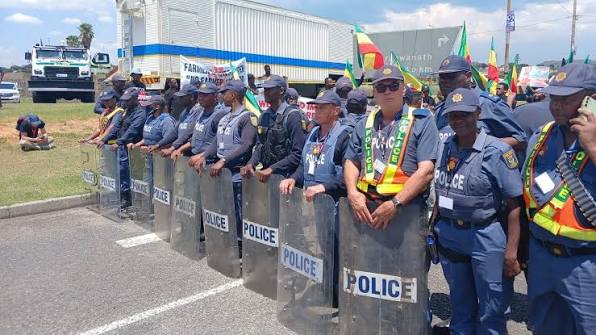
Supporters of the group, joined by members of Operation Dudula and other affiliated organisations, began assembling under heavy police and private security presence. Early footage and reports from the scene showed a large deployment of public order policing units and security personnel that, at least in the initial hours, outnumbered the protesters who had arrived. The demonstration was restricted to the speakers’ corner near South Beach, deliberately kept away from the Durban International Convention Centre (ICC) precinct to protect the security of heads of state and other dignitaries.
The group called on all SADC heads of state to prepare for what it described as a massive deportation of all illegal foreign nationals from South Africa by 30 September 2026.
The movement, founded in 2024 by former radio presenter Jacinta Ngobese-Zuma, rose to national prominence earlier this year after organising nationwide protests on 30 June. That day marked an unauthorised deadline the group had set for undocumented foreign nationals to leave the country.
More than 20 civic organisations took part in demonstrations across all nine provinces. While most of those events remained peaceful, a handful involved isolated incidents of intimidation and violence.
Ngobese-Zuma has repeatedly vowed that Thursday protests will continue until the government responds to the movement’s demands. The organisation has argued that South Africa cannot continue to absorb large numbers of undocumented migrants and has called for stronger border management, increased funding and staffing for the Border Management Authority, and decisive enforcement action.
Today’s protest coincides with South Africa formally assuming the SADC chairship for 2026/27. President Cyril Ramaphosa is chairing the gathering of the 16-member bloc. In remarks made in the lead-up to the summit, Ramaphosa urged South Africans to feel “deeply concerned and ashamed” about discrimination and violence directed at people from other African countries, stressing that the country could not pursue closer regional integration while such treatment persisted.
Authorities had prepared extensively for possible disruption. National Joint Operational and Intelligence Structure (NATJOINTS) chairperson Lieutenant General Tebello Mosikili warned days earlier that while peaceful and lawful protest is constitutionally protected, criminality, intimidation, property damage or any attempt to disrupt the international gathering would not be tolerated. KwaZulu-Natal police confirmed the march route had been carefully managed to keep protesters well clear of the ICC.
SADC executive secretary Elias Magosi told related meetings over the weekend that the region remains generally stable and free from interstate conflict, though he flagged the eastern Democratic Republic of Congo and Madagascar as the bloc’s most pressing concerns. Immigration itself does not appear to feature as a formal agenda item, yet the protest has placed the issue firmly on the public stage.
The March and March action forms part of a broader, sustained campaign that the movement insists will continue weekly until its core demands are met. For now, the streets of Durban have become the latest arena in which South Africa’s heated debate over undocumented migration intersects with the politics of the wider region.